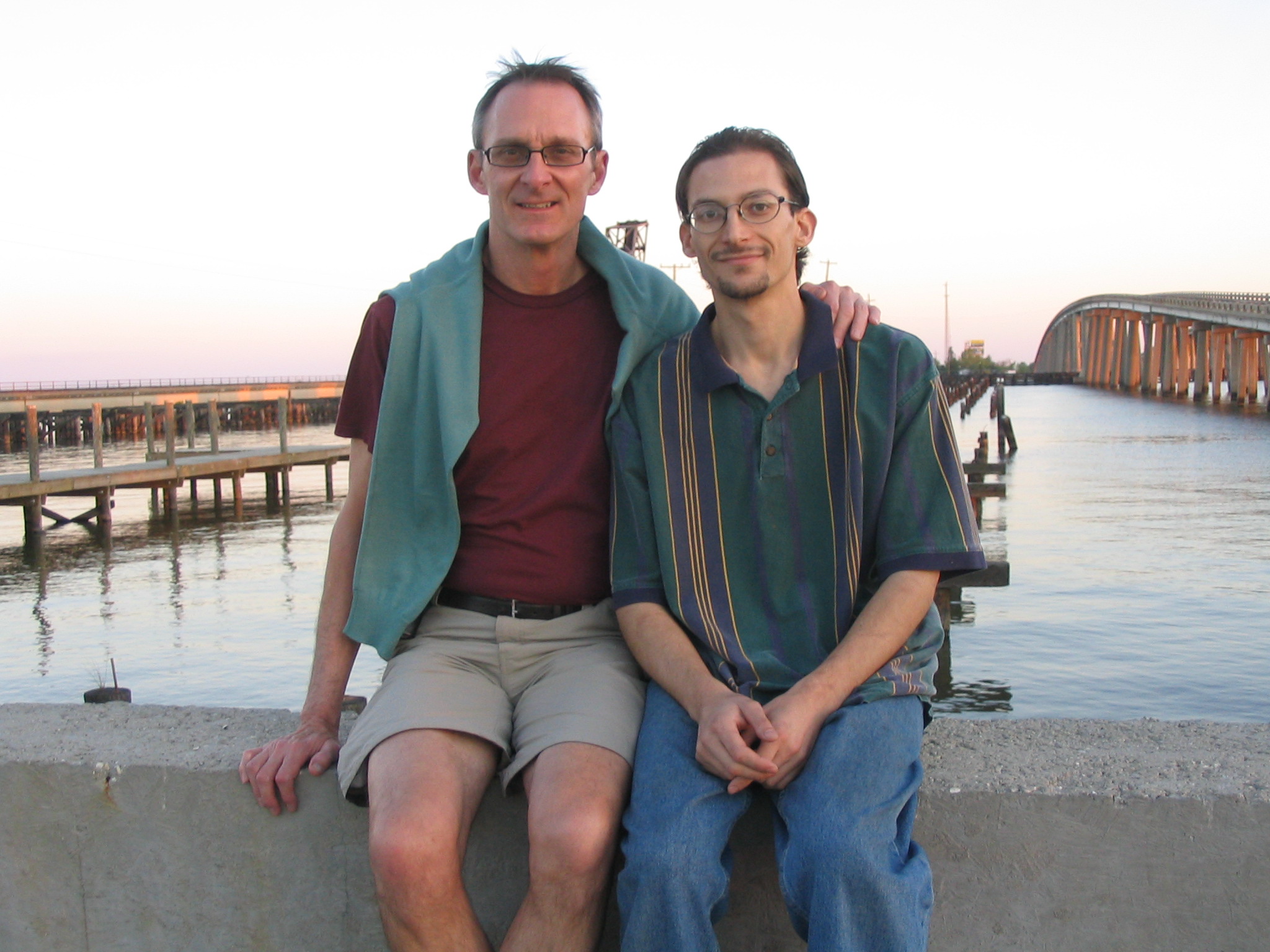
For Dillon: On the occasion of what would’ve been his 44th Birthday
by Jack A. Urquhart, Copyright 2023
Occasionally, two or three times a year, I tune my heart to the memory of your face to the sound of your voice, to the sly, crooked angle of your grudging smile And sometimes you come in loud and clear your half-assed, fake anger broadcasting some oldie but goodie, egregiously insulting, clear as a fifty-thousand-watt station on a cloudless day: “You’re nothin’ but a big old whore!” I hear you bray again, loud enough for the whole neighborhood to appreciate in splendiferous ROFLOL style. But other times, there is only the painful static, of your complete and utter silence. They say the power of a loved one’s absence fades with time until, like a canyon echo the reminders coming ’round again, diminish with each reverberation But I think it’s only that we’ve become harder of hearing, our attentiveness damaged by the decibels of everyday life. Until we become deaf and numb And finally, in tune with absence, just another voice in the ether– competing for attention. Waiting to be remembered– As I remember you.
Today, August 2, 2026, it’s thirteen years since you left us.
Every year I try to write something to mark the day, something that will reassemble a small part of you. And every year, I’m less successful in that effort. So I hope you will excuse, dear son, this latest attempt.
How, after all, am I to reanimate in any meaningful way a lost son—especially one so adept at emotional hide and seek as you were during your brief thirty-four years amongst us?
For the thirteenth time, I browse your old photos today, looking for clues that will bring fleeting life to dusty memories.
As always, I recall your beautiful hands (a gift from your mother) and your thrumming, slender, ever-anxious fingers—the hands of a diffident artist.
Other snapshots freeze-frame your awkward gait—the way you kept your arms swingless and tight against your torso, as if you were unsure of how much room you had any right to occupy in the world.
I’ve written before about your well-documented trademark smirk—a wary half-smile, turned down at one corner against the world. As if at any moment mirth might slide seamlessly into disappointment.
But these are trivial pursuits that always lead me to a familiar dead end: I can never put you back together again, Dillon. Never have you back again. And yet I can’t let go of the bits and pieces of you either. Not yet.
It’s been four years since you left us, dear man. And five or six times since then that you’ve paid me a quick visit.
Maybe you remember how it goes?
Sometimes you keep your distance—waving hello from the top of a hill. Other times, we’re together face-to-face in the same room—you looking young and handsome in your favorite striped shirt, the one you wore on the day we met.
And always there’s your same tentative body language—that head-cocked distracted half smile, like you’re feeling the press of time, something beckoning your full attention away. Like you’re already late for another appointment.
Like you know as well as I that it’s all a dream, nothing more than a few electrical signals stitching an unlikely narrative out of cosmic static.
But so what if it is!
For a few synaptic moments, I have you back again. And what ephemeral, blissful happiness your presence brings!
And just so you know, it doesn’t matter that our encounters are followed by a longing for what once was and is no more. I wouldn’t have it otherwise, Ray. Not on my life.
For what makes life worth living if not those chilblain-inducing moments of overwhelming, unexpected, always fleeting joy?
All these silly words just to say: Yes. Please come again, dear man. Whenever you can. Whenever you have time.
Today, March 8th, is your birthday. Had you lived, you would be forty-seven.
Forty-seven! Imagine that.
Sometimes I try.
I imagine what kind of person you’d have become, how you might have found your place in the world, if you would have escaped that darkness you fell into so young.
You know, the medical experts say that schizophrenia in males typically develops during the late teens to early twenties and that the telltale signs are social withdrawal, emotional swings, disorganized thinking, sleep disturbances, and alcohol/drug experimentation and/or abuse. In fairness, these are behaviors that might be exhibited by any adolescent or early post-adolescent. They are behaviors that might seem unremarkable to the untrained parental eye.
Or to the chronically distracted.
Or to the wishful-thinking, harried father grumbling: “For Pete’s sake, this is just adolescence! And here I am, busting ass, trying to make a living!”
Good lord, the red flags you fanned right under my nose, Dillon!
I can’t help reflecting on that old saw that persons contemplating parenthood should be required to obtain a license—the same as for any potentially lethal activity or undertaking. Certainly, you, dear son, might’ve benefited from such a legal safeguard.
But like many before me, I thought I could do a star turn in the parental arena (despite the lack of preparation or responsible motives). Your absence, son, is a testimony to my arrogance, my ignorance.
You see, I thought unmitigated, unfiltered love was all one needed to be a successful father. Silly me not to foresee that such a naïve approach to parenthood would expose the child—brought willy-nilly into the world without a say in the matter—to a host of unavoidable life-threatening dangers.
Such risk-inviting behavior was, at least for me, motivated by a Freudian out-of-control-romper-room Id-driven urge to procreate, to love—and possibly the most reprehensible of all motives—to be loved in return.
Sad but true: contrary to popular belief, love—especially an immature notion of it—cannot conquer all.
Nevertheless, I wanted you.
From an early age, maybe 10 or 11, I wanted you, Dillon. I planned for you, dreamt of you, wrote your name—alongside your dream siblings—on the back cover of my favorite novel (it was David Copperfield, at the time). I thought the life your dream mother and I would write for you (she would, I fantasized, have clouds of dark hair and look like Merle Oberon in “Wuthering Heights”) would rival anything in the literary canons. It would rival anything Hollywood could bring to the screen.
Talk about magical thinking!
But children are not characters in a book. They are not larger-than-life, airbrushed, idealized actors. They cannot be written, much less imagined, into some silver-screen existence. Children arrive—you arrived (screaming bloody murder, I’ll note!)—with inscribed-in-the-DNA drives and priorities that cannot be edited away, dreamed away, or cajoled away. Certainly not by a distracted parent.
I cite this distraction because, from the start, your challenges ought to have been obvious to me, Dillon. You had poor impulse control (like me). You had a predisposition to melancholy and passive aggression (like me). You were given to secrecy and furtiveness (like me). You craved instant gratification (like me)—all of which, I ought to have discerned, were signs of a potentially addictive personality (like mine).
You must have been ten or eleven, way late in the course of your life, before I finally understood all that.
And then, I wanted the kit and caboodle—every inherited liability—to go away. Magically, if possible. But if not, then talked and encouraged away. By me. By your mother. Your sister. By those hired to the task of “therapying” your inherited issues into non-existence.
To reiterate, I wanted all the unhappy birthday gifts you’d received from me gone—by any means possible.
And, it turns out, it was possible.
Turns out, after much trial and error, you found the means, readily available on the back streets of Seattle.
And so, without fanfare, planning, or intention, you banished your terrors—all of them. You made them—and yourself—vanish.
August 2, 2013. That is when you left us, Dill; seven months short of your 35th birthday.
Another lethal overdose in a Seattle park, they told us.
Perhaps you can sense that all the foregoing is heavy on my mind today. That is because thirteen years ago, when I was still reeling from your loss, someone (with plenty to spare) told me that I lacked compassion.
It was a stinging rebuke, but with the ring of authenticity.
I saw her point and how it applied to you. I saw the truth—when it was too late to make a remedy; it’s water under the bridge now, but I offer this brief epistolary history as a poor one. Think of it as a belated birthday gift to you. And to myself. It is my admission of complicity in setting your life trajectory, Dill.
It is my apology.
You deserved better than you got from me, dear son. You deserved a less distracted, more thoughtful, compassionate fatherly consideration of your challenges, and a better celebration of your many gifts. You deserved years and years of happy birthdays.
You deserved a better state of being; I hope that, wherever you are now, you’ve found it.
Every now and then I capture an image of you, Dillon. As ever, you are hazed, wide-apertured, posed, albeit in a second-hand context:
The young barista’s coffee-stained fingers, graceful, as an artist’s instrument, the hands of an unrealized classical pianist.
The slouching young man at the convenience store counter -- shifting foot-to-foot against the tedium of purchasing cigarettes.
Everything quietly screaming The urgency of being done. As if the quotidian were insufferable.
That was like you, Dillon – the forced grace, the impatience and hypersensitivity, The susceptibility to sensory overload.
No wonder, then, your need for respite, For an artificially filtered calm, for an absence of noise, and excessive saturation for the blissful neutrality of nothingness.
That is how, in the dark rooms of my heart, I process your absence These twelve years on -- How I attempt to soft focus one of our last several encounters: That time when you said, flat voiced, all seriousness, “I never asked to be here.”
For my late husband, Raymond Boyington, on the third anniversary of his passing
Arriving in the post today clutch of Kodachrome memories, gift from a friend perhaps clearing, as I cannot, the archives of a shared history, i.e., decades-old photographs of you freshly launched, sapling-thin, lost inside a 70s polyester suit, cross-armed and cocky in cable-knit – not to mention the aviators, epic mutton-chops, and vaguely licentious mustache. Dear God, there you were again, spilling from a Kodak envelope, artifact from another era.
More images to join the others strung, fading, curling, across my kitchen casement my closet doors, above the lintel. Like yellowing leaves from the tree of life we made, they flutter and abide, autumnal remnants of all our favorite seasons.
Which is not to say there haven’t been others since, digitally framed attachments, new intimacies – some too fleeting, too young, too hopeless for permanent display. Lovely beings encountered in your absence; some of them searching for, perhaps wary of finding, what we experienced: that life-giving melding of flesh and spirit – The One Prayed for, The One longed for.
And now, suddenly, in this late life season, a new melding, a new love – prayed for, longed for – living alongside you in the beating frame of my resuscitated heart.
And yet, Dear man, focus of my mid-life journey, I cannot put you away, cannot set aside the captured moments of our quarter century union, cannot countenance the finality of archiving you, of making you sight unseen.
If you’re listening, if it matters where you are, then I hope you’ll take note: today is March 8th, which would’ve been the 46th anniversary of your birth. If only you’d survived.
There have been many “if onlys” since you left us. So I can’t help wondering if you might’ve lived if we’d chosen differently.
There were, after all, other routes we could’ve taken, paths other than those that led us to where we are now – if only we’d chosen more conventionally, more selflessly. If I’d chosen familial fidelity? If you’d chosen something other than deadly false euphoria?
Then what?
But what do I know of the forces that mapped your path? Was I even there to witness your struggles – your first steps toward oblivion?
And if not, then doesn’t that make me complicit in your absence?
Ironic, don’t you think – that we’ve both found our private devastations (if that even matters in the grand nameless, heartless scheme of things).
What’s beyond supposition is that despite the bonds of age, the obligations of bone and blood, and paternal love, only one of us survived. And, so what(!) – if it was me?
When it should’ve been you.
Happy birthday, Dillon – if you’re listening. If it matters anymore.
(For my son-in-law, Aaron Hartzell, 11.09.1974 – 03.10.2024, on the anniversary of his birth)
It wasn’t always easy taking a walk with you. Rather, it could be an eye-roll-inducing experience — the way you (camera ever-at-the-ready) tarried to examine every eye-catching blade of grass, every play of light in a leaf-littered rain puddle, not to mention the attention you lavished on the salt-bleached flotsam and jetsam at Ocean Beach.
But oh my, the images you captured (sometimes at the expense of our patience): Dew drop pearls, like a spider-web necklace strung between strands of beach grass, a universe of stars radiant in a mud puddle, sandcastles accumulating on a battered beach stump, even halos around our mugging, hurry-it-up faces.
An eye for life through a camera lens was your brilliance, an eye for beauty in the odd and the seemingly ordinary — that was your gift to us, the legacy of your too few years. Thank you, dear man. Thank you for helping us see.
Since you’ve been gone, I have made of You an alter replete with the relics of your life and times: your compass, your slide rule, your red plastic comb (tacky in its donnish pocket liner). These rest atop the rosewood box, home to the yet-retained dust and dirt of You.
Nearby, favorite photos mark time with the miniature clock radio, my first gift to You, and that decanter of lavender-olive oil (always too pretty to open). I’ve filled your prized glazed bowl with a favorite Parisienne memory: the chestnuts we collected on a cold, damp December morning—Jardin du Luxembourg, the whole magical place all to ourselves.
Next to them, a few votives and an empty bottle—Pavillon Rouge 2000 Du Chateau Margaux—still carry the dust of your last Birthday celebration.
All this evidence of absence, these alterations, sit the Northernmost corner of my little house, the one You never saw. I used your compass to plot the exact true North of your resting place. I’ve placed your car keys there, too, in that ugly woven basket, the one You refused to relinquish.
To this day, all my comings and goings—all my navigations—begin and end there. With You, Dear Man.
This year, it’s eleven. Eleven years since you left. I keep thinking about the significance of that number. It’s prime, of course, like you, capable of being measured out by no one and nobody, but yourself and the incorporeal, inscrutable Number One. And God forbid anyone else -- least of all, me -- should try. But I did. We all did. Although perhaps not enough? And so, it seems you stepped up to do the job for us divvying yourself into a host of separate entities; the cantankerous lot of you confined in that too-tight space, engaged in a constant argument, and imagined subterfuge, and self-destructive drama. Until maybe the cacophony was too much, too much for you to bear? I wonder about that sometimes -- about how you coped with the internal racket and exactly when it was you decided to stop, and how you must’ve felt in that moment of self-determination, in that moment of enough, just enough already; a measure of silence, a measure of peace, please. And whether you’ve found it at long, lost last?
(For Raymond L. Boyington on the second anniversary of his absence)
I calendar your absences,
Dear Man (did you know?).
I employ the plural, absences,
because there are many:
One hundred and four Saturdays,
a little less than two trips
around the as-ever sun
infinitely indifferent
to the tortured meanderings
of our human grief.
Interesting, don’t you think
that the Earth’s orbit
runs counterclockwise?
What a perfect metaphor
for the age-old longing
to run time backward.
Believe me, I can relate.
It has been hundreds of days,
Thousands of hours,
A million minutes and counting
since you took your leave.
And you, the irrecoverable void
at the center
of every second.
I know it’s weird,
but I am compelled
to track these empty spaces,
these entry-less days, weeks, months.
And now, years.
Like a force of habit, some might say.
But that simile will not suffice.
For you were the calendar
of my life.
The one entry writ large
in bold font, all caps
across every page,
the one appointment
that could never be canceled.
And that holds true,
To this day, My Love.
So, yes. I will keep the calendar,
Of these absences
For you were the man
at the center
of all my seasons.