Anyone’s Opulence, the Silk Floss Tree, by @JackAUrquhart

©2012 (700 words)

The silk floss tree (') in , , Spain.

Last weekend, the central Florida burg where my partner and I live held its annual residential Garden Tour.  It’s a big deal in these parts—a pay-for-view event that affords locals and out-of-towners the opportunity to access some of Mount Dora’s loveliest private Edens—many of them contiguous with its comeliest homes.  Throngs turn out, wallets agape, for a glimpse of horticultural splendor in the last days of autumn before the first frost.

Rather than queue for the show, my partner and I went biking.

We decided to take advantage of the marvelous weather—mid-seventies, low humidity (finally!)—to get some exercise along with our sight-seeing.  Besides, we were eager to escape our neighborhood, suddenly overrun with lookie-lous in SUVs.

Soon we were pedaling east away from our rental bungalow, eventually crossing Highland Avenue into a part of Mount Dora where the town’s Queen Ann dowagers, its renovated farmhouses and Spanish colonials, are less ubiquitous.  As were the signs advertising the Garden Tour.

I know that in many parts of the country one needn’t travel far to encounter evidence of residential stratification.  Yet here in the south—where manicured lawns and carefully tended gardens can in the distance of a few city blocks give way to whole neighborhoods of scrub oak, skunk vine, and Virginia creeper—that transition can seem particularly jangling.  And yet there is something appealing about the shift as well, something invigorating about all those acorn-strewn raked yards and wild thickets of native flora.

So I was content to let my partner lead the way into less familiar parts of town.  Besides, it was obvious that Ray had an agenda—one that he revealed some thirty minutes into our ride.

“Remember that flowering tree I told you about?  The one I saw last week on my way home from the grocers?” he called over his shoulder as we coasted down Simpson Street.  “It’s over here on the eastside somewhere.  A stunning sight.  I want to find it again.”

And we did—find it, that is.

How lucky am I, I ask you, to have such a persistent partner—a man not given to hyperbole in his choice of adjectives?  I can claim as much because a silk floss tree (Ceiba speciosa) in full bloom is indisputably a “stunning” sight.

Hardy and common in central Florida (though Ray, a Yankee boy born and bred, wouldn’t have known that), the silk floss’s avocado-green trunk and branches—both capable of photosynthesis—are studded with lethal-looking conical thorns.  Indeed, the tree’s coarse armaments would seem to provide an environment incompatible with the delicate, bright pink flowers that explode across its canopy September into November.  And yet the blossoms, shaped like fragile champagne flutes, unfurl in splendiferous numbers.

I suppose some folks might balk at the notion of a common, hale and hardy tree out-showing the showiest, most carefully cultivated gardens.  Yet turning onto an east-side side street last weekend, Ray and I encountered the living proof.  For there it was, a deciduous, fifty-foot work of art … on exhibit … in front of a nondescript 50s ranch-style house, the yards thick with goose grass and knotweed.

It’s a cliché, but braking to a dead stop in the street that afternoon, it came to me—an inchoate notion that the silk floss is a kind of arboricultural metaphor of the happiest sort.  It seemed to me that there was something about the tree’s natural beauty—a splendor one doesn’t have to pay for, that isn’t limited to the most desirable neighborhoods—that was tremendously heartening.

I’m still not quite sure why I was so affected.  Maybe it was the tree’s “wow factor” on display for the entire world to see; maybe it was just its stand-and-gape extravagance that I found uplifting.  Or perhaps there was something about its honest majesty that offered a shred of hope—that in this crazy, secernated world, where even nature has become a commodity subject to the price of admission, there is still opulence that anyone can afford.

Like I said, I’m still mulling it over.  But I’m almost convinced that’s what got to me.  A garden of truth as simple and as accessible as that.

Posted in Uncategorized | 7 Comments

Book Review: Chantal Thomas’s “Farewell, My Queen”; Celebrity Worship Syndrome in the time of Marie Antoinette

By Jack A. Urquhart ©2012 (992 words)

Recently the UK’s Mail Online ran an article entitled, “Do you have Celebrity Worship Syndrome?” along with a quiz “to measure the reader’s ‘CWS’ symptoms”.  One of the T/F quiz statements was, “I enjoy watching my favourite celebrity”; another read, “I have a special bond with my celebrity.”

The piece put me in mind of Chantal Thomas’s engrossing historical novel, Farewell, My Queen, which I’d just finished reading.  The link in my thought loop can probably be traced to Thomas’s description of life at Versailles, circa 1789, on the eve of the French Revolution—a time when celebrity worship remained enshrined in decades-old court ritual; a place where courtiers never ceased obsessing over the high and mighty or stopped touting their connections to the court’s most celebrated residents, Louis XVI and his glamorous but vacuous Queen, Marie Antoinette.

To my mind, Thomas’s novel makes a good case that answering in the affirmative to any of the The Mail’s CWS quiz statements would have been as risky to body and soul in 18th century France as it would be practically anywhere today.  One could argue, as perhaps Thomas intended, that mindless celebrity worship, especially when celebrity is undeserved or ill bestowed, was and is a waste of time and human potential.  However, that premise, even if proven, would not lessen the appeal of Thomas’s fictional account of Marie Antoinette’s Versailles.  Rather, Farewell, My Queen manages to be one of those guilty literary pleasures (the emphasis on ‘literary’ is intentional) akin to soaking up an especially well-produced episode (if there ever was such a thing) of Lifestyles of the Rich and Famous.  That is because Thomas packs her novel with enough glamour, enough excess, enough suspense—enough insider information—to inspire fresh interest in a tale whose conclusion is no mystery.

It helps that, besides being a gifted writer, Thomas is well qualified to take on her subject.  An expert in 18th century literature and a scholar of French history, she gets down to business quickly by introducing Agathe-Sidonie Laborde, the novel’s first-person narrator.  An all but invisible court functionary, Laborde provides a fly on the wall perspective of the French Court during the early days of the revolution (Thomas adds a soupçon of irony by making her narrator a lowly “reader to the Queen”).

First encountered in 1810, some twenty years after the Queen’s execution, Laborde is living the life of an elderly exile in Vienna.  Yet neither time nor distance can diminish the image of the woman she still calls “my Queen.”  A dyed-in-the-wool royal groupie, Laborde begins her narrative by attempting to replace a queen known for her profligacy, who even at the height of her powers was deeply unpopular, with a rose-petal-pink goddess—kind, fragrant, beautiful, “a light that never goes out.”

That she fails in the attempt can be attributed to a classic case of mission creep.

Laborde’s starry-eyed portrait of Marie Antoinette as a beautifully turned out, gentle sovereign—a Queen who dispenses kindness to courtiers and servants alike—is richly detailed.  Yet, the narrator’s idyll shatters when she begins to include the less savory aspects of court life.  It turns out that one of the entrancing afternoons Laborde recounts—hours spent observing the Queen thumb the pages of a fashion magazine—occurred simultaneous to the storming of the Bastille.  Likewise, the royal banquets Laborde describes (“four main courses, twenty side dishes, six joints of meat, fifteen regular desserts, thirty little desserts, a dozen platters of pastry…”) are either gobbled by the royals—or in the Queen’s case, picked over and discarded; meanwhile, ordinary French citizens starve to death.  According to Laborde, even the gilded cages at the royal zoo house sickly, neglected animals.

And then there are the narrator’s memories of the palace itself, Louis XIV’s magnificent château famed for its Hall of Mirrors, for its richly appointed apartments, its priceless paintings and statuary.  Laborde’s Versailles, however, is (literally) a seat of pestilence: its beautifully furnished rooms, infested by rats; its lavish gardens constructed upon reclaimed swamplands still swarming with mosquitoes.  In fact, Thomas repeatedly invokes the château’s deceptive splendor as a metaphor for what ails the court and the country.  Everywhere, it seems, there is decay and corruption lurking just below a pretty façade—a façade that is only a few days away from destruction.

Things go south in a hurry when King Louis XVI submits to the National Assembly and dismisses his foreign army.

Left unprotected at the wide-open château de Versailles, the courtiers panic as news of the countrywide riots spreads.  The Paris mob is on the march, headed for the château, a list of “286 heads that have to fall” in hand.  In short order, the freeloading nobility, like rats from a sinking ship, flee the palace.

But not Louis, the stout little man who never wanted to be King, who prefers forging locks in the royal smithy to the tedious rituals of the court and the incomprehensible duties of government.  And not his (in)famous Queen.

In a final act of courage, the royal couple remains at Versailles to meet their fate.

Laborde narrates these final days paying particular witness to the frazzled and dazed Queen as she rallies to arrange the flight of her favorites, including Laborde herself, who eventually escapes to Switzerland.

The novel’s conclusion is sudden, providing little in the way of closure.  But perhaps that is an appropriate narrative choice on the author’s part.  In fact, it may be that Farewell, My Queen demonstrates how quickly things can come crashing down—no matter how celebrated, or deeply entrenched in seemingly unassailable ritual and/or culture.

Surely this remains a worthwhile aide-mémoire in the twenty-first century given how the powerful (and those who idolize them) are just as apt as ever to be blinded by the klieg light glare of celebrity.  So disastrously blind, in fact, that sometimes they cannot discern how fragile is the foundation upon which their illusions rest.

___
Farewell, My Queen, by Chantal Thomas; First published in the U.S. 2003 by George Braziller, Inc.
Originally published in France 2002 by Éditions du Seuil under the title Les Adieux à la Reine.

Posted in Uncategorized | 2 Comments

Pop Quiz for a Religious Zealot?

By Jack A. Urquhart ©2012  (1500 words)

English: Titlepage and dedication from a 1612-...

English: Titlepage and dedication from a 1612-1613 King James Bible, printed by Robert Barker. (Photo credit: Wikipedia)

Last week I received an e-mail from a stranger—a response to a comment I’d posted at an online publication.

“Beware what you commit to the Internet,” a much more cautious friend is always telling me; “you never know when someone may come looking for you.”  And there it was, the proof of his wisdom…blinking from my computer screen.

It all started when I read an online article reporting a southern clergyman’s remarks on the upcoming U.S. Presidential election.  Specifically, the cleric had opined (in terms unmistakably toxic) that church members should eschew any political party that supports gay rights.  I believe my comment, posted at the web site, went something like this:

It seems inappropriate for a clergy person to be dictating virulently phrased political instructions from the pulpit.

Words to that effect.

A few days later, the aforementioned e-mail arrived; here is the text:

Dear Lost Homosexuol (sic): The Lake of Fire yawns for you!  Remember, our savior, Jesus Christ, is the only way to God.  Study the KJB!  In the end, every knee shall bow and every tongue will confess him to be so.

My immediate response was:

  • Says who? followed by
  • KJB?  What does the former Soviet Union intelligence agency have to do with this?
  • And then, the obvious: Why would this person take the trouble to message me?

It took me a while to think it through—to settle on the probable explanations to the questions noted (I can be slow on the uptake):

  • First: It’s The Bible, dummy; that’s ‘who says’;
  • More specifically, The King James Bible (KJB); [Not the K B. Duh!]
  • And finally: I live in the American South, the land of evangelicalism and religious proselytizing; the land of Biblical inerrancy and ‘our-way-or the Hell-way’—any one of which is sufficient to explain a response from a stranger.

Why be surprised, then?

But I was.

I was surprised because the timing of the unexpected e-mail was so precipitous.

You see, as a matter of curiosity I had lately begun a study of the Bible’s history (an informal, layman’s study, admittedly, and not part of any ‘born again’ epiphany).  And my online critic’s e-mail caused that curiosity to crystallize around a question that must have been percolating at the back of my mind.  Specifically, I found myself wondering if there were many others here in the South who, like this Baptist boy, had reached adulthood without having acquired—despite decades of Sunday School, not to mention annual stints in vacation Bible School—a historical perspective of the Bible?  Had all that Sunday schooling been an education or something else … dare I suggest it—an indoctrination?

So I decided to take some of what I’d gleaned from my Bible studies over the last few weeks, a few pearls of KJB history, and to compose (and no, I don’t mean to imply that I’m casting anything before swine) the following ersatz brain teaser.  I decided to put together a little pop quiz for my e-mailing Zealot—not that I’d any intention of forwarding it along.

So, here is my quiz; feel free to test yourself if you’re so inclined.

1.  King James I undertook the Biblical translation bearing his name for which one of the following reasons:
a.  The previous version of the Bible featured an unattractive font
b.  His predecessor and cousin, Queen Elizabeth I, had mandated the project in her will
c.  The previous version of the Bible (the Geneva Bible of the Protestant Reformation, circa 1560) included objectionable anti-monarchist notations.

2.  The translation of the KJB, undertaken between 1604 and 1611, was the work of:
a.  Three angels, working temp status, under a contract executed by His Majesty, King James I, and the Archangel, Michael
b.  Eleven Biblical scholars claiming to be Jesus’s original disciples in reincarnated form (Judas was still doing time as a snake).
c.  47 scholars—some of them poorly versed in Greek—working in three teams.

3.  The translators of the KJB used which of the following as their source material:
a.  An annotated version of the Ten Commandments
b.  Illustrated papyri discovered in the Great Pyramid of Khufu
c.  Previous Greek translations of the Gospels that were themselves translations of translations from the original Hebrew and Aramaic texts.

4.  The italics featured in most versions of the KJB are:
a.  Words attributed to Jesus, the Virgin Mary, and the Old Testament Burning Bush
b.  A glitch in the typesetting effected in 1611 by employees of Robert Barker, the King’s Printer
c.  Portions of the Greek text of the Bible that the translators couldn’t quite decipher (i.e., the translators’ best guess at an English equivalent)

5.  How many textual revisions to correct errors and ‘refine’ meaning have been effected to the KJB since 1611?
a.  None.  The Archangel Michael, acting on behalf of God, certified the translated text ‘inerrant’ in 1611.
b.  Only one.  Subsequent theologians changed Matthew 1:18, which previously read “Mary was found to be with Child” to yield a word-for-word English translation of the Greek text—the result, “Mary was having it in the belly.”
c.  Over 100,000

6.  How many Bible verses are commonly cited to condemn homosexuality in the KJB?
a.  365, one for every day of the year
b.  69 (for obvious reasons)
c.  8

7.  How many of those purportedly anti-gay verses were spoken by, or have been attributed to, Jesus?
a.  Every single one, fool!
b.  Sheeze, such a Doubting Thomas!  You are this close to being turned into a pillar of salt!
c.  None

8.  In translating the Greek text into English, the KJB’s translators rendered the word, arsenokoitēs [ἀρσενοκοίτης] as “abusers of themselves with mankind.”  What other meanings have been attributed to this word by Bible scholars?
a.  Friends of Dorothy
b.  Show tune aficionado
c.  A perpetrator of incest and/or rape; one who exhibits weakness or effeminacy; a practitioner of prostitution and/or exploitative pederasty

9.  Which book(s) [Chapter and Verse] in the KJB purportedly deal with the threat of male-on-male sodomy?
a.  Book of Bruce, Chapter 77 verse 99
b.  Matthew, Mark, Luke, and John
c.  Genesis 19:1-29 and Judges 19:1-30

10. Two KJB stories deal with hosts who protect their male guests (purportedly) from homosexual gang rape (see 8c above); the stories are God’s judgment on Sodom and Gomorrah and the story of the Levite’s concubine.  In both stories, how are the male guests protected?
a.  The hosts douse the mobs with saltpeter
b.  The hosts provide the mobs with farm animals for fun and games (see the Prophecies of Rick Santorum)
c.  The hosts satiate the mobs by giving them females from their own family (and wouldn’t that have been passing strange, given the supposed proclivities of the rabble)

11. What became of the Levite’s concubine (see story referenced above)?
a.  Her charms and allurements restored the members of the homosexual mob to a state of righteous heterosexuality and she went on to become a renowned sex therapist
b.  She abandoned the Levite, became a prophetess in her own right, and went on to write the Book of Judith (the text of which male ecclesiastics subsequently banished to the Apocrypha)
c.  She was thrown to the mob, sexually assaulted all night long, and then subsequently chopped into 12 pieces by the Levite (Judges 19:29)

Extra Credit:
12. True/False:  The books of the KJB New Testament are arranged in chronological order.

See answer key below.

So…how did you do?

Okay, lest this little scholastic enterprise seem designed to denigrate the good, the admirable, the worthy life teachings found in the KJB, or any other version of the Bible, I hasten to make clear that that is not my intention.

Rather, I  mean to suggest that it is perhaps more appropriate to eschew didacticism, and to consider the tenets of the ‘Good Book’ within their cultural and historical contexts.  I mean to suggest that perhaps it is better to spend our time culling the passé from the timelessly relevant, and then applying some old-fashioned common sense to what’s left, before embarking on any life-shaping endeavors (including proselytizing to strangers via the Internet and other venues).

I mean, for goodness sakes—isn’t it obvious that the scriptures have, for centuries, been filtered (countless times) through the fallible minds of translators, scribes, and printers?  Isn’t it likely that they have been shaped by the cultural perspectives of numerous civilizations (for example, the ancient near East’s first and second century insistence on male superiority)?

Anyway … that is my conclusion.  And, yes, I know that some folks will say—as my e-mail respondent has—that having abandoned the tenet of Biblical inerrancy (not to mention having embraced the dreaded ‘homosexuol (sic) lifestyle’), I am thus a lost soul.  But I don’t think so.  I’m pretty sure it hasn’t gone missing yet—my soul, that is.

And while I don’t pretend to know the mind of God (Heck! I can’t begin to fathom the enormity of ‘God’), I can’t help thinking that Mind, if ‘mind’ is even an appropriate analogy, is far too grand and too inclusive to have settled on a single path—much less a single inerrant textual road map—as “the only way” home.

That thought (along with the forgoing ‘quiz’ thrown in for fun) is how I might have chosen to answer my e-mailing zealot—had I been inclined to do so.

But who knows?  Maybe I just did?

_____

Answer Key, Quiz:
1 – 11:  c.
Extra Credit: False.

Reference Material

KJB Bible passages commonly used to condemn homosexuality:

  1. Genesis 19:1-29 (God’s judgment on Sodom and Gomorrah)
  2. Judges 19:1-30 (the rape of the Levite’s concubine)
  3. Leviticus 18:1-30
  4. Leviticus 20:1-27
  5. 1 Corinthians 6:9-17
  6. 1 Timothy 1:3-13
  7. Jude 1-25
  8. Romans 1.
Posted in Uncategorized | 2 Comments

Book Review: Binocular Vision, by Edith Pearlman; “Cautious words make the story convincing”

By Jack A. Urquhart ©2012 (890 words)

I have been trying to fathom what it is about Edith Pearlman’s marvelous Binocular Vision (Lookout Books, January 2011) that makes this story collection such a treasure.  That is why it was almost a relief to stumble upon the “cautious words” quote attributed to her and referenced in the title of this review.  In truth, there doesn’t seem to be a single recklessly placed word in the 34 stories—13 of them previously unpublished—of this, her most recent collection.

How then, I kept wondering in making my way through one astonishingly understated tale after another, could it be that I’d never heard of Pearlman before my partner’s enthusiastic recommendation?

Happily, I’ve since discovered, I can take comfort in the fact that Binocular Vision and its author seem to have taken even much of the mainstream literary establishment by surprise.  This is strange given that Pearlman is the author of over 250 works of short fiction and non-fiction, as well as three previous story collections; it is doubly strange when one considers that Binocular Vision is the only book ever to be nominated for the National Book Award, the Story Prize, and the National Book Critics Circle Award in the same year.  That distinction will, in short order, prove justifiable to anyone fortunate enough to undertake Pearlman’s collection of short fiction.

This reader, for one, would be hard pressed to recall stories more alive with intelligent, thoughtful, highly principled characters—men, women, and children confronting a variety of human predicaments odd and frightening, heartbreaking and humorous.  I can honestly say there isn’t a story among the 34 that I didn’t like and there are at least five or six that I count among the best I’ve read.

That Pearlman’s protagonists face their individual dilemmas while maintaining an eerie sense of calm detachment seems in keeping with the author’s “cautious” approach to story telling.  Indeed, Pearlman’s prose is so deceptively simple and coolheaded, so composed, that the reader sometimes barely notices the thermostat being turned up a few emotional degrees until suddenly, they are in the flush of a breathtakingly revelatory moment.

In the story, “Inbound,” a precocious seven-year old girl accidentally separated from her parents during a Boston day trip undergoes an intellectual/psychic transformation and returns to her parents in the first blush of a dawning adult sensibility.

She foresaw…that as she became strong her parents would dare to weaken.  They too might tug at her clothing, not meaning to annoy…She felt her cheek tingle, as if it had been licked by the sad, dry tongue of a cat…She had to return to her family now; she had to complete the excursion.

In the beautifully moving “Tess,” a mother looks in lovingly on her bedridden daughter, afflicted from birth with permanent physiological and neurological damage, and then calmly surpasses—in a single compassionate act—all the well-intentioned humanity of an entire hospital’s professional staff.

I put the blanket back on.  I watched her ear for a while.  All those windings and curves. My little girl’s little ear.

I got the toy she liked best from the windowsill. The red floppy dog.  They always forgot it.  I put it in a corner of the crib.  Then I unscrewed the end of the heart tube from the aqua clothespin and I slipped it under the blanket so the blood would pool quiet and invisible like a monthly until there would be no more left.

In another gem, “On Junius Bridge,” a scrupulously reserved innkeeper—whose establishment provides safe-haven to an ever-changing gaggle of introverts and misfits—foils the kidnapping of a wealthy guest’s autistic son and is shocked to find herself offering a well rehearsed sanctuary.

“Lars is not particularly precocious, doesn’t read anything except entomology, doesn’t even read very well,” [the boy’s father said.]

She favored him with her expressionless gaze.

“My brother in New york… he too is…narrow.”  She spoke at last, as loudly as she could.  “It is possible that in a century or two the interpersonal will cease to be of value.”

“Practiced by a few eccentric devotees,” he agreed.  “Like swordplay.”

“I could keep the boy,” she heard herself cry.

“No,” he said, perhaps sparing her, perhaps turning the remainder of her life to ash.

The collection’s final piece, the stunning “Self-Reliance,” presents a retired physician in her 70s who, confronted with resurgent cancer, decides to navigate life’s ultimate challenge with typical independence.

Cornelia pushed off vigorously, then used a sweep stroke to turn the canoe and look at the slate roof and stone walls of her house…Then, as if she were her own passenger, she opened a backrest and settled herself against it and slid the paddle under the seat.  She drank her concoction slowly, forestalling nausea.

Sipping, not thinking, she drifted on a cobalt disk under an aquamarine dome.  Birches bent to honor her, tall pines guarded the birches.  She looked down the length of her body.  She had not worn rubber boat shoes, only sandals, and her ten toenails winked flamingo.

These are stories that steer clear of facile epiphany, that (as in real life) rarely achieve resolution, but that relish—always with an understated modesty—the sudden disclosure of a simple, sometimes unexpectedly fundamental, verity.

Perhaps it really is, then, that brilliantly executed modesty, that ‘cautious’ artistry, that renders Pearlman’s stories so beautifully and completely…convincing.

Posted in Uncategorized | 3 Comments

GWM Seeks GM 4-Evermore

By Jack A. Urquhart ©2012  (881 words)

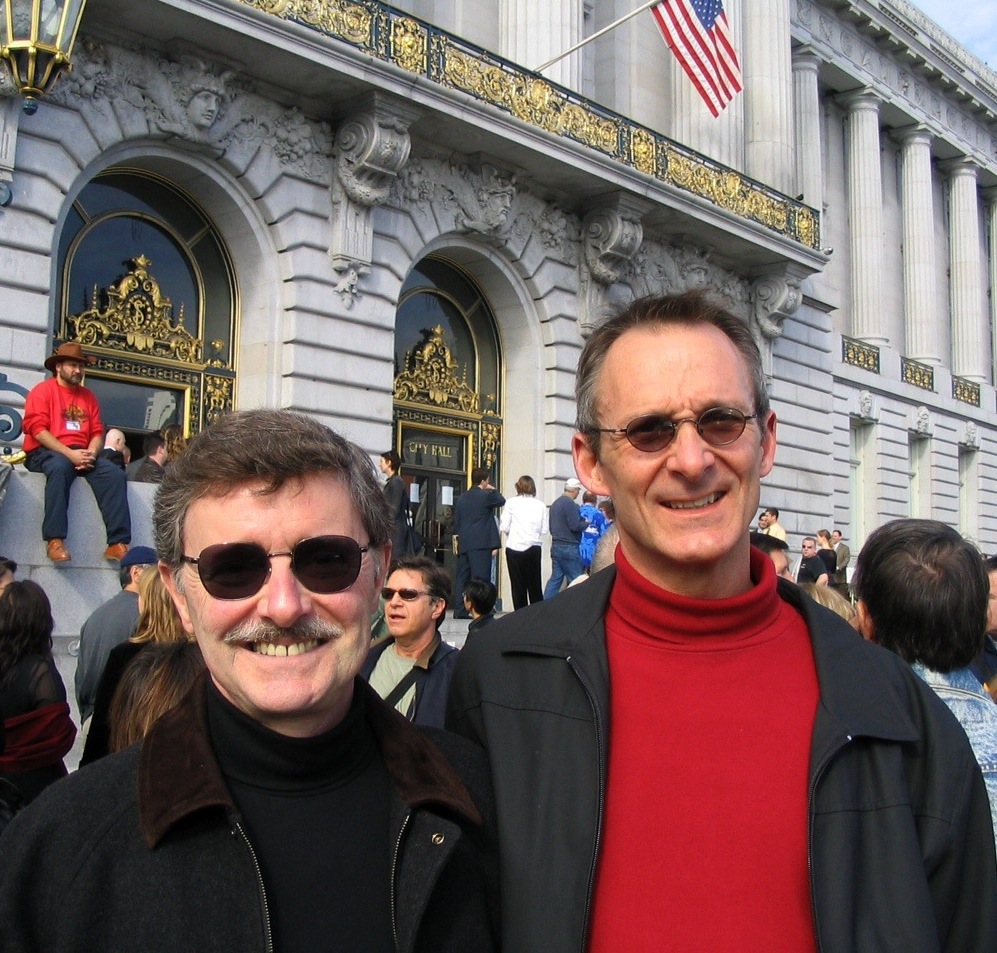
On August 11, 1998, I met my spouse, Raymond, at a San Francisco coffee-house.  Church Street it was, a Tuesday afternoon if I recall correctly.  A recent transplant from Boulder, Colorado, I’d been in the city a month to the day.

My plan in coming to San Francisco had always been to achieve exactly what commenced that afternoon—namely, to find and then settle with my life partner.  What can I say, I’m a romantic, hopelessly steeped in domesticity.

Nevertheless, I’ll confess that on that Tuesday p.m., I was more interested in sampling the city’s considerable gay confections than in shopping for a mate.  Just out of a two-year gay relationship, and only three years removed from a heterosexual divorce (and separation from my children), I had a sweet tooth for distraction.  ‘Playing the field,’ a sport I’d never undertaken, seemed just what the doctor ordered—the perfect orientation to my new life in Gay Mecca.

I placed a tame little ad in the Yahoo personals and was shocked to receive over a dozen replies in the first two hours.  Within days of my arrival, I’d set about the business of meeting and greeting with the intention that, at least for the time being, ‘Mister Right Now’ would do me (nasty little pun, that) just fine.

It was fun.

I met many men, all of them amiable, kind, and yes—even shy.  Some of them seemed interested in me, some didn’t.  I was attracted to several of them, not so much to others.  A month of playtime ensued—the games quite safe, if not outright platonic.  I would’ve been fine with having the distractions continue a while longer, but fate, or luck, or chance intervened, and I met Ray that Tuesday afternoon.

In no time I was smitten—and resistant.

Smitten because he was emotionally honest with me from Jump Street—a rare quality among men, in my limited experience; resistant because the connection seemed effortless.  Surely one had to flounder more than we!  Like great art, a great relationship ought to involve some small degree of suffering, right?  Perhaps a little drama?  Not so with us.  We talked easily from the beginning—about our lives, past and present, our work, our previous relationships, about partners lost and/or misplaced, friends and lovers gone and much grieved.  It helped that we had much in common: both of us previously in heterosexual marriages, both fathers, both of us teachers or formerly so.

Fortunately, our tastes and personalities have (over time) proven complementary in some arenas, and (at least) convergent in others.  Ray does not suffer fools gladly; I tend to smile and make nice.  He is focused, single-minded; I entertain five or six thoughts simultaneously.  Ray is a scientist; I barely passed high school chemistry.  Luckily, we are both introverts who love our quiet time.  Hours pass, Ray in his study, I in mine, during which no more than a dozen words—called out one room to the next—are exchanged. More good fortune that we both love music, art, and literature—though not always the same genres.  Nevertheless, he finds time to read, edit, and proof everything I write, and has been the driving force in seeing me into print.

Not to be forgotten in the mix, our respective childrens’ ups and downs, which are topics of regular discussion, celebration, commiseration.

As for the quotidian mundanities, like most long-term ‘togethers,’ we divvy up domestic responsibilities.  Ray does the grocery shopping, does the cooking (lord, what a blessing!), and handles all things technology.  I clean the house, attend to the laundry, pay the bills.

Fourteen years it has been.  But it might just as well have been fourteen minutes for the speed with which the time has flown by.  So many memories.  So much forgotten.

But not this:

On that first ‘date’ back in 1998, I remember that after leaving the coffee shop, we hiked up Corona Heights, Ray and I, to admire the San Francisco view.  There at the summit we shared a single, chaste kiss before parting company.  What a pleasant afternoon, I recall thinking.  I certainly hadn’t counted on anything more.

I hadn’t counted on persistence.  On curiosity.  On patience.  On generosity and passion.  I hadn’t counted on unconditional love.

Today, all these years later, I depend on all those blessings—sometimes even taking them (and their benefactor) shamelessly for granted.  But I also depend on Raymond to know how much, and how completely, I love him—even on the days when I forget to say so.  I count on him to know that he is the first person I want to see when I open my eyes of a morning, the only person I want to kiss good night—the one I will reach for in the wee hours when dreams turn ugly.

I count on him to know how grateful I am.  Every.  Single.  Day.

That we are a couple.

 Yahoo! Classifieds

Date posted: 07/14/98

 Description:  Divorced GWM mature, seeking another mature GM, 42-55, for friendship and maybe more.  I am a likeable guy, educated and unpretentious, and fully capable of emotional/intellectual/physical intimacy.  You should be, too.  LTR possible but not mandatory.  Sound interesting?  Your response and photo gets mine.

Hobbies/Interests: Community Service, Movies, Music, Writing, Outdoor Activities.

Posted in Uncategorized | 8 Comments

Three Lies I Told

By Jack A. Urquhart ©2012 (700 words)

Truth lies

Pity parties are never fun.  After all, there’s really nothing to celebrate, and who wants to be invited.  Nevertheless, I’ll admit I’ve been whooping it up lately, mostly in private but not always, beating myself up for the many ‘sins’ that underpin my failures and shortcomings.

If I were still a religious person, the obedient Baptist boy I was raised to be, I’d prostrate myself before ‘the Lord,’ confess everything (or as much as I can remember), and go begging after forgiveness.  But I don’t go down on my knees like that anymore—except for more earthly, utilitarian pleasures…like gardening, scrubbing the floor, the rowing machine at the gym (and shame on you for thinking anything else!).

Fact is, I’ve had my fill of celestial sacrifice and salvation mythology.  Besides, if God is out there, I figure She already knows my scorecard backwards and forwards and has better things to do than pay attention to my groveling.

That said, there’s much to recommend a good purge now and then, for admitting the worst of oneself in the service of lessening (if only temporarily) the heavy burden of disappointment and regret accumulated across the years.  And since it appears I’m overdue for divestiture, why not take advantage of this forum (it’s so much cheaper than a shrink)?

So, to get to it, what follows are three of the many varieties of lies that I’ve told accompanied by an unadorned, un-explicated example of each.  Whether the samples be whoppers or little white whippersnappers (I’ve plenty of both in my trunk) is not for me to say.  All I know is that I’ve been toting them long enough that attempting to shake them here doesn’t seem a bad idea.

Feel free to comment and to share your own fibs and fabrications if you think it might lighten your load.  Or not.

  1. Lies of Wishful Thinking.  At nineteen, I told my best friend I was ready to marry her and to be a good father to her child by another man.  I did neither.  Instead, come the day of scheduled cohabitation, I drove out to purchase gas for the moving vehicle and never returned.  That lie cost me one of the truest friends I’ve ever known.  Deservedly.  Oh, wishful thinking—how many hearts have been broken in your name!
  2. Lies of Good Intention.  When my children were tykes, I told them they were the most beautiful beings in the world, and that great things were in store for them—careers, acclaim, an easier time than dear old Dad ever had.  That was a series of lies, you’ll say.  True.  And how disappointing for them to find out first hand what a struggle being alive really is.  Parenthood!  Maybe they should issue licenses?  Good intentions aren’t enough.
  3. Lies of Cowardice Years ago, when I was a banker, it fell to me to fire another employee.  The decision to terminate, made by the board of directors, was ostensibly because of a small bookkeeping error made during the employee’s first week on the job.  We’re talking a loss to the bank of less than a hundred dollars—chump change even in those days.  But that was a lie, and I knew it.

The real reason was that the poor Schmo had passed the afternoon of his first day on the job with his fly open, a situation that caused him no end of mortification once a co-worker found the courage to speak up.  No big deal you’ll say, just an unfortunate case of nerves and forgetfulness—the sort of mishap that could befall any guy desperate to make good in a new position.  And you’d be right.  The guy was no pervert.

Nevertheless, I followed through on the board’s instructions, repeating to the employee (with as much conviction as I could muster) the false reason for his termination.  The poor guy cried.  So did I; because I felt bad for him.  But mainly because I was ashamed of having supported an egregious falsehood.  Don’t know if there’s a connection, but ‘executive’ is a role I’ve never since pursued.

So there.  Three lies out of millions (and yes–I know the categories overlap).  But do I feel better for having confessed?

Ask me later.

Posted in Uncategorized | 7 Comments

Fathers and Sons: Paternity from a Distance

By Jack A. Urquhart ©2012 (885 words)

Though Father’s Day is well behind us, I have been stuck lately in Daddyland unable to shake the notion that even though my children have somehow managed to reach adulthood in one piece, there is still so much potential for a paternal fuck-up.  None more potent, I think, than the peculiar minefield that is the father/son relationship.

This latest worry can be traced, I think, to my son’s current difficulties (what young man doesn’t have a few?).  Difficulties the specifics of which it would be inappropriate to mention here, but which beg the question: what is it about the father/son relationship—or more specifically, our father/son relationship, “D”’s and mine—that makes it so difficult for me to feel comfortable (after all these years) in stepping back a few paces, in eschewing the fixer role, in vacating the space that only my son should rightly occupy?

What am I afraid of?  Why, of losing him, of course!

I can remember a time when there was so much less—fear, that is; when to hold my son close, to offer reassurance and guidance when he came to me with a skinned elbow or a school problem, was almost as easy as breathing.  I can remember holding “D” asleep in my arms and thinking that any existent God would surely have trouble creating again a being so marvelous, so beautiful, with half so much potential (silly me, three years later his sister came along!).

I can remember thinking that there was nothing I would ever do that would be more important than taking care of him, than protecting him.

All that began to change when “D” turned twelve.

Okay, so I’m well acquainted with the explanations (scientific and pseudo-) that would account for the difference.

No doubt about it, a young boy confronting adolescence has a lot on his plate.  Aside from a passel of mind-blowing physiological transformations and urges, there’s the impetus to begin creating an autonomous, independent life of his own and to begin peopling that space with friends and intimates quite apart from Daddy dear.

Of course, it doesn’t simplify matters that the son’s adolescence-triggered changes are sometimes concurrent with Dad’s own messy mid-life crises.  Is it any wonder then that Pops should slip a bit—or a lot—from any pedestal he might previously have occupied?  I mean, think about it!  How immensely discouraging must it be for a young person—witnessing these hapless fathers who despite all their years and experience can’t seem to avoid screwing up?  And how much worse the special situation of a boy in mid-adolescence whose Dad happens to be coping with the inescapable fact of his homosexuality?

A lot worse, I expect.  As it must have been for “D”.

So, obviously all the forgoing played a role in the changes that began occurring between my son and I some twenty years ago, factors that jarred us into the current phase of our relationship—the phase that I think of as Daddyhood from a distance, paternity from the sidelines (quite literally now that “D” lives on the other side of the continent).

And yes, I understand that such changes are an appropriate part of the child’s maturation process.  Yet, I can’t help fretting over the intimacy that seems to have gotten lost as my role as protector gives way to something else—to something more like an advocate.  I can’t help wondering what it is that makes so many of our exchanges, “D”’s and mine, seem cursory—that makes even the flat-out fact of the words “I love you” ring heartbreakingly hollow over the telephone line?

So here’s my latest theory: that there’s something about our evolving perceptions of each other that makes each of us afraid.  Maybe for “D” it’s the reality of his father’s many imperfections that undermines confidence in the notion of a steadfast paternal love?  Maybe something about my unwillingness to step in as often, to fix and repair as unfailingly, that makes him doubt the depth of the father/son connection?  And so, he holds back?  He doesn’t reveal himself?

And for Daddy Jack?  Well, perhaps it’s the fear that my son will not see in himself—that he cannot see all by himself—the good that I see?  All the potential?

And as I’ve already indicated, maybe it’s just the God-awful fear that I will lose him.

So how would I wish things different in our relationship, what accord would I have us reach?

While I can’t speak to what that might look like from “D’s” perspective, from my own I’d wish that he should understand—really understand—how much I love him.  Enough to step back and allow him to stumble, watch him fall, witness his pain.  Because I have to—I have to do it each time in the full knowledge that I might be committing a colossal paternal fuck-up.

I’d have him understand that I keep some space because I want him to experience the satisfaction of reclaiming his life of his own initiative.  Because I want him to discover that he can.

And I’d wish him to know how proud I am when, after each mishap, and given all the difficulties he lives with day-to-day, he finds the strength to try again.

Yes, I guess I’d wish all that.

For my sake, surely.

But for his, too.

Posted in Uncategorized | 2 Comments

Karma, BJs, and Putting a Foot Wrong

By Jack A. Urquhart ©2012 (985 words)

This week I have been thinking about Karma.

Okay, it’s more than that.  I’ve been thinking about foot injuries, too.  And blow jobs.

That is because I have—by reason of an operation to correct a neglected runner’s injury—been put literally off my feet; and in that stasis has come the impetus to examine action and consequence—even (bear with me) among such disparate subject matter.

What?  Gone looking for Karma in things as facile as plantar fasciitis, a common running injury, and (of all things!) fellatio?  Isn’t that a bit self-indulgent?

Well, yes.  But when one is flat on one’s back, it is sometimes difficult to prevent an occasional false start down ‘All-About-Me’ Avenue with all its peculiar twists and turns.

Just so, I’ve been chasing after connections.

Granted, I have only a rudimentary comprehension of Karma’s Indian, Buddhist, and Vedantic traditions—not much beyond the notion that a person’s actions and conduct affects his or her destiny.  I am, however, a little more familiar with Karma’s less sophisticated American cousin, or more aptly, the branch of the family that still thrives in the American South.  In that neck of the woods, the Karmic praxis survives in the phrase, “What goes around, comes around,” and the Biblical axiom, “be sure your sins will find you out.”  It’s a potent legacy—one that defies easy expurgation.

Witness the fact that I’ve been worrying all week, “Maybe I brought this on myself—this injury, this bone-burning immobility.”

It all goes back to 19-sixty something, the year I spent in Bloomsburg, PA, and my high school rival, Dwight Higgins (not his real name) in the 440-yard dash.  I was fourteen, and Dwight, a year older, was my competitor for a slot in the Columbia County All School track meet, the only school-sponsored athletic endeavor that ever caught my fancy.  But Dwight was more than a competitor; he was also my chief tormentor, a homophobe par excellence long before the term went mainstream.

His most memorable abuse against me—which took place hard on the eve of the 440 elimination trials—was to place a twenty-five cent piece on my desk during art class one afternoon during the teacher’s absence and to proclaim for the benefit of the class that the sum was advance remuneration.

“He’ll give anybody a ‘BJ’ for cheap,” Dwight announced, going on to say that I would provide a ‘lip-smacking’ demonstration later that afternoon (downtown behind the Sears Roebuck dumpster, I believe it was to be).

It didn’t help that I had to ask the girl seated in front of me what was meant by ‘BJ’.

“It means you’re a queer boy, a sissy, and that you ‘go down’ (yet another mysterious term!) for guys,” she obliged to ringing laughter.  Words to that effect.

No matter that I rejected Dwight’s twenty-five cents.  From then on, I was marked: “BJ-Jack.”

Oy.

Back then, I didn’t know what it meant to be gay, certainly hadn’t self-defined that way yet.  I knew only that there was something about me that provoked Dwight’s particular brand of peer abuse, something that went beyond having girlishly long eyelashes, being super skinny, and loving Edith Piaf (although those attributes doubtless played a big role).  The worst part was that whatever the mysterious quality, I too was aware of its existence.  I could feel the truth of it—that there was something about the way I related to the world that marked me as different.

“It means you’re a queer boy, a sissy…”  “He’ll give anybody a ‘BJ’.”

And there is nothing that fuels the desire for revenge any better than sensing an iota of accuracy in a peer’s taunt.

It took some doing, plotting a course against Dwight.  Mine involved his Onisuka Tigers (quite expensive running shoes in those days) left unattended in the locker room on the day of the 440 trials, and a bottle of capsaicin topical (I think it was Sloan’s Horse Liniment).  You can probably guess the rest: a quarter bottle of liquid fire per running slipper, a warm day in May, sockless feet?

Poor Dwight.

The short distance he completed before dropping out of his heat that day—before tearing off his Tigers in a howling frenzy—gave new meaning to the term, “hot-footing it”.

So how did I feel afterward, after those first few moments of blistering satisfaction?  I felt afraid—initially of being found out (I wasn’t); then came the guilt.  I was certain my dirty deed would come back to haunt me, that I was a bad person—if not exactly for the reasons Dwight had posed.

Baptist upbringing runs deep.

As I’ve indicated, in the South (where a few civilized folk still read Austen), “it is a truth universally acknowledged” that you can ‘be sure your sins will find you out.’  And sure enough, Dwight Higgins has dogged me across decades.  He showed up in Colorado to thrum my conscience in the early 90s in the aftermath of a training run injury.  And again here in Florida two months ago when my left foot, put wrong, hooked up with a pothole during a 6:00 a.m. run—the event that led me to this recovery bed.  Ever persistent, Dwight was back last night at 3:00 a.m., back to waggle a shaming finger when the place where the bone has been carved away from my left foot underwent an attack of fire and brimstone.

Poetic justice?  Confirmation that what goes around, comes around?  Proof positive that to be vindictive, queer boy or not, is to put a foot very wrong indeed?

Karma?

Or is it all nonsense, another manifestation of how difficult to practice forgiveness of the self-exonerating variety?  Just another way of holding on to a long-gone and best-forgotten past?

As in the still-to-this-day impetus to proclaim (loudly in certain circles), “No!  goddamnit!  I do not give BJs to just anybody!

Posted in Uncategorized | 1 Comment

Book Review: The Termite Queen: Volume Two, by Lorinda J. Taylor; Mostly Successful Conclusion to an Engrossing Saga

By Jack A. Urquhart ©2012 (1400 words)

Readers familiar with the initial installment of Lorinda J. Taylor’s ambitious saga, The Termite Queen: Volume One: The Speaking of the Dead (386 pages, hard copy), know that Taylor is a vastly talented writer.  Happily, Taylor’s storytelling prowess doesn’t often falter in the mostly satisfying conclusion of her epic sci-fi adventure, The Termite Queen: Volume Two: The Wound That Has No Healing, itself a formidable undertaking at 572 pages.

Though the author modestly characterizes TQ as literary Sci-Fi, the description doesn’t begin to capture the full flavor of Taylor’s accomplishment.  Rather, in TQ V 1 and 2 the author serves up a tome that crosses genres as easily as her intergalactic cast of characters crosses from real-time space travel to temporal quantum space travel and back again.  In fact, the complete TQ saga is part traditional love story, part epic adventure tale richly seasoned with mythic and religious overtones, as well as copious references to literary classics (each chapter is introduced by a literary epigraph).  That said, it is not incidental that Taylor’s epic is set in the thirtieth century (2969—2971).  Hardcore Sci-fi aficionados will appreciate that Taylor’s literary recipe includes science so convincingly researched and/or fabricated as to concoct a perfectly plausible and believable future.

It helps that Taylor’s ‘future’ is inhabited by a cast of engaging and believable characters—human and alien.

Background; TQ characterization and narrative stances

Once again, Taylor’s chief human protagonist in TQ V 2 is the gifted young linguistic anthropologist, Kaitrin Oliva.

Readers of TQ V 1 (which encompasses parts 1 and 2 of Taylor’s saga), will recall Kaitrin’s introduction as the up-and-coming young academic asked to study a giant termite specimen brought back to earth following a disastrous mission to the planet, 2 Giotta 17 A.  Not only does Kaitrin succeed in bonding with the terminally ill creature, she also cracks the termite’s electromagnetic language and in the process earns the respect and affections of renowned entomologist, enigmatic Professor Griffen Gwidian.  Kaitrin’s linguistic triumph secures for her a prominent position in the return expedition to the termite planet—an expedition to be led by none other than Professor Gwidian.

The couple’s romance comes to fruition during the weeks of deep-space travel recounted in TQ V 1.  A moving ceremony performed en route joins the couple in matrimony and provides a window into Griffen’s mind.  It turns out Taylor’s Gwidian is a man who harbors a deep personal secret, a burden so encrypted in guilt and secrecy that even Kaitrin—with all her intellectual and intuitive powers—cannot crack the code.

In both TQ V 1 and 2, Taylor employs alternating storylines that shift between what is happening among the members of the scientific expedition and the dramas unfolding within the termitarium.  It is a strategy that showcases the author’s ability to create fully realized personalities—a talent not limited to Taylor’s human characters.  Indeed, the author manages the same success with most of her aliens—beings as far removed from human sensibilities as Avians (witness the feathery and endearing Professor A’a’ma) and the termites of planet 2 Giotta 17 A.

For the most part, Taylor accomplishes this difficult task with her termites by presenting their storylines in screenplay format.  This narrative stance gives the author free rein to exercise complete directorial control down to the smallest detail of setting and characterization.  In fact, the author’s stage directions in both TQ volumes are so specifically ‘Taylor’ed to the individual termites that it is sometimes possible to tell them apart without glancing at the attributions denoting their complicated names.  By the time the scientific expedition nears the termite planet at the conclusion of TQ V 1, the reader has encountered most members of the termite cast.

Chief among them is the termitarium’s third-highest ranking inhabitant, the noble shaman, Kwi’ga’ga’tei, who in a vision foresees the imminent return of the ‘Star beings’ (the moniker applied by the termites to their other-world visitors).  Charged with maintaining the peace and survival of the termitarium known as Lo’ro’ra, Kwi’ga’ga’tei is not without her antagonists.  The ringleader of these is the crafty Mo’gri’ta’tu, Chamberlain to the termitarium’s highest ranking inhabitant, the Termite Queen.

Even before the scientific expedition reaches 2 Giotta 17 A, Taylor makes it clear that the termites are not immune to the power struggles that foment civil unrest, rebellion—and even murder—on earth.

Volume Two

It is at this point—just as the scientific expedition makes landfall on 2 Giotta 17 A—that Taylor picks up the action in Volume Two: The Wound That Has No Healing, which encompasses parts 3 and 4 of the TQ saga.  Indeed, the first 342 pages of TQ V 2 move, for the most part, at a pace snappy enough to keep the reader fully engaged and, at times, breathless with anticipation.

Soon after the expedition makes landfall, Kaitrin makes contact with Kwi’ga’ga’tei.  As her bond with the shaman deepens, Kaitrin’s understanding of the termite language, social hierarchy and customs, as well as their religious beliefs, increases.  But that is not all she begins to understand.  Indeed, Kaitrin senses the power struggle unfolding within Lo’ro’ra—a struggle that threatens her new friend’s authority.

What Kaitrin doesn’t realize is that the evil termite Chamberlain Mo’gri’ta’tu is the leader of a conspiracy to assassinate Kwi’ga’ga’tei, and that the ‘star beings’ expedition, and more specifically her own evolving relationship with the shaman, has placed her in the conspirators’ crosshairs as well.  Soon after Kwi’ga’ga’tei brings Kaitrin (literally) inside the termitarium—where she finds favor with the termite queen (A’kha’ma’na’ta) and her consort king (Sei’o’na’sha’ma)—the conspirators put their plans into action.

Taylor adds to this mix of tension and turmoil Gwidian’s increasing anxiety as his new wife undertakes risk after risk in the name of science—none more upsetting to him than Kaitrin’s ventures inside the termitarium.  Indeed, Gwidian’s almost pathological obsession with his wife’s safety—an obsession linked to the dark secret of his traumatic youth—fuels his increasing emotional instability.  Things literally begin to fall apart for him when, during what was to have been Kaitrin’s final visit inside the termitarium, the conspirators break into open rebellion.  With his wife in harm’s way, Gwidian, driven by his relentless internal demons, throws himself into the thick of battle.

As the termite rebellion concludes, Taylor finishes off part 3 with several gut-wrenching scenes replete with New Testament overtones and literary references (Shakespeare, Andrew Marvell, to name two)—allusions that will resonate with readers well-read in the classics.  Soon afterward, the traumatized ‘star beings’ abandon the termite planet for earth leaving much unfinished business in their wake.

Unfortunately, in undertaking the novel’s Part 4 conclusion, subtitled “Earth: Absolution,” Taylor relinquishes much of TQ V 2’s forward momentum.  She does so by straying from one of the cardinal rules of fiction: “show it; don’t tell it.”  It is a tendency that crops up from time to time in TQ V 1 as well, but which the author generally abandons after a few pages.  Not so in TQ V 2, Part 4, the focus of which is Kaitrin’s quest to: (1) uncover the dark secret responsible for her husband’s torment, and (2) find expiation for her role in the doomed mission to planet 2 Giotta 17 A.  Taylor chooses to ‘tell’ the story of Kaitrin’s quest almost exclusively in dialogue—i.e., pages and pages of conversation between Kaitrin and several women from her husband’s past.

It is unlucky that Part 4, with its enervating narrative stance, stretches to some 200+ pages—an authorial choice that vitiates much of the impact of Gwidian’s dark secret when it is finally revealed.  Equally unfortunate is the fact that the relentless dialogue actually retells much of Part Three, thus all but inviting the reader to skim.

Fortunately, Taylor breaks the tedium by offering a brief but emotionally satisfying epilogue to the novel—one that sees Kaitrin return to 2 Giotta 17 A for the resolution of her unfinished business with the termites of Lo’ro’ra.

Despite the lapses noted, TQ V 1 and 2 amounts to an impressive literary accomplishment.  Indeed, Taylor’s strengths are in evidence on nearly every one of the tome’s 958 pages.  Few writers are up to such an undertaking—one requiring as much meticulous, laborious attention to research and the fabrication of history, language, religion, and science as to a proficiency of narrative technique.  For the most part—and that is a great deal in the case of TQ V 1 and 2—Taylor lives up to the challenge.

Jack A. Urquhart is the author of several works of fiction, including So They Say Collected Stories.

Posted in Uncategorized | Leave a comment

A Daddy’s Day Dispatch

By Jack A. Urquhart  ©2012  (1100 words)

Dear Dillon and Devon,

I’ve never cared for Hallmark holidays the likes of Father’s Day—never thought there was much cause for receiving tokens of appreciation from my children for discharging my parental responsibilities.  After all, you didn’t ask to be born.  Rather, your mother and I made that choice—we brought you both in love into a world that is at best unevenly disposed to kindness, and where struggle is for most of us a quotidian enterprise.  Indeed, I expect you, my all-grown-up kiddies, could make an argument that I should be thanking you for having enriched my life.

It is with that thought in mind, and with Father’s Day fast approaching, that I choose to reverse the accepted order of things this year by serving up this little ditty of memorabilia.  I offer it freely to you—and to any others who care to eavesdrop (you are welcome here!).  It’s not much of a Father’s Day gift.  Merely a sampling of this Daddy’s memories offered in token of my ongoing love and devotion.

Beginnings are a good place to start, don’t you think? And birthdays?  Those memories linger brightly in my mind.

They say first born children often take longer coming into the world, and Dillon, that was certainly true of you.  For the longest time—14 hours and then some—you couldn’t decide:  would it be Wednesday or Thursday?  It took a suction cap, applied to the crown of your diffident little noggin to get the show rolling.  You arrived—scarlet, wrinkled, histrionic to the high heavens—on March 8th, 4:44 p.m.  It was snowing in Boulder, Colorado, that afternoon—a cold, wet, spring snow swooping down off the Flatirons, the flakes clumping into cotton ball clusters.

My first parental role was to bathe and dress you—a task like trying to swaddle a greased sausage.  As I struggled to master the art of diapering, the attending nurse cautioned that I should be on my guard  “in case your little man decides to squirt”—a prophecy which you quickly fulfilled.  I remember that your PJs featured little blue and yellow choo-choo trains.  And, of course, there is the memory of your Mom, luminous after her long ordeal, laughing, crying, arms eagerly outstretched to receive you when I brought you to her room.

Three years later, your sister Devon was in a much bigger hurry.

You allowed barely three hours, my Dear, between your first timid stirrings and a confident, unceremonious grand entrance, 12:21 p.m., September 21st .  It was a Tuesday, and from the beginning you were quiet and observant—barely even whimpering in the delivery room.  Even then, you were gorgeous: ruddy from head to toe with whorls of black hair and lips that would’ve put Angelina Jolie’s to shame.  Like your brother before you, I bathed and groomed you for your first family reunion.  I don’t remember your first outfit, Devon, but I do remember how you behaved when I placed you in your mother’s arms, the way you pursed and puckered your lips, as if you were blowing kisses, until you found your mother’s breast.  Nobody had to coax you—you knew just what to do.  Your brother was present as well—the two of you regarding each other askance from opposite sides of the hospital room.

Other memories:  I recall you, Dillon, at eight years, irritable during one of our family hikes in the Sangre de Cristos near Ouray, Colorado.  It was a beautiful summer day, the four of us heading home on the downhill trail, your mother and I dog tired, when you, impatient with the family’s slow pace, decided to go it alone.  I remember, Dill, how, despite multitudinous parental warnings, you went scuttling ever farther ahead, certain that your mother and I would be too exhausted to intervene.  It couldn’t have been more than ten minutes after you disappeared from view when your frightened cries came echoing up the trailhead.  I remember a moment of hackle-raising terror—thinking bears, thinking mountain lions—as I went racing downhill in a guilty panic.  There were so many side trails.  One after another I searched them, desperate to find you, determined when at last I had you locked in my arms, howling like a banshee, that you’d be grounded until your 21st birthday—a punishment I fully intended to implement—as soon as I could bear to let go of you, as soon as I could stop nuzzling the top of your head, dear stubborn, irreplaceable, devastatingly beautiful little boy.

Children have a way of augmenting your worst days in a manner that rings back ridiculous—and endearing—years later.  As on the day that you, Devon, at age 4, decided it might be fun to shove a peanut up your nose.  In fairness, daughter Dear, how were you to know that I would add to the merriment by choosing that same day to inform my boss that I thought him a bona fide arse—a pronouncement that while immensely satisfying (not to mention, accurate) was enough to get me canned.

Two hours we were at the emergency room that afternoon, the whole family—your mother and I wondering if the insurance provided by my now former employer would cover the expense of extricating that recalcitrant nut from your dainty schnoz.  Meanwhile, you and your brother played in the hallway as if all the troubles of the world amounted to naught.  Eventually it took a team of nurses, aided by your mother and I, to corral you for the attempted extraction.  And then you made us all look like fools.  I shall never forget, Devon, your powerful sneeze and the sight of that snotty missile all but launched into orbit.  Later that evening, you asked for the comforting rhythms and repetitions of Dr. Seuss and fell asleep while making your own rhymes in sighs and saws against my chest.

I could go on wandering down memory lane, kids, but I won’t.  Instead I’ll offer this final bit of hard-earned Father’s Day advice—offer it to you, my children, and to any other interested parties in attendance.  Here it is:

Sometimes (often?) the most priceless moments between parent and child—between any two individuals—barely register in real time. 

That is because we Dads and Moms—we human beings—are too busy, too distracted, too tired, and/or too selfish to recognize and appreciate them: the wonders transpiring right under our noses.  Yet, inevitably, these casualties of inattention come back to haunt us, their visitations triggered by old photographs, by bizarrely altered dreams, by family stories told and retold.  They come back to remind us of times lost.

This little fact of life, my Dears, is my Daddy’s Day gift to you.  I offer it in the hope that you might profit from my oversights and omissions.  In the hope that you, better than I, might savor all the little miracles that come your way—as much in the present tense as in the past.

Yours with love,

Dad

Posted in Uncategorized | 5 Comments