A Few Words for Mom, by @jackaurquhart

©2013 by Jack Andrew Urquhart       1124 words

Mom 2013, Ninety years young.

Mom 2013, Ninety years young.

On the afternoon of December 7, 2013, I received the telephone call that most of us think (and hope) will never come our way: the call that informs us that a loved one has suddenly been taken.  In my case, the one taken was my Mother, Thelma Ashley Urquhart, killed in an automobile accident in front of the church where she’d been a devoted attendee and member for over fifty years.

She’d just attended a Christmas luncheon for the ladies of her Sunday school class.

What follows is a slightly edited version of the remarks I offered at her memorial service, December 12, 2013.

A few words then, for you, Mom.  With my love. –Andy

Purple squiggle 14

Good morning. On behalf of my brother and the family, I thank you for being here today to celebrate Thelma Urquhart’s life.  She would be so pleased—is pleased, I think, to see such a fine turnout.  That is because—as she’d be the first to admit—Mom liked being the center of attention, and she appreciated being on the receiving end of a little affection.  So it looks like she hit the jackpot today.

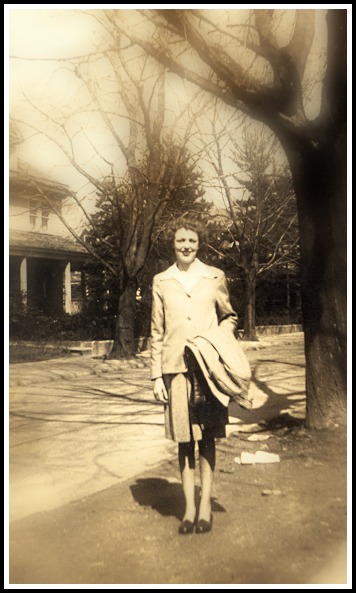
Mom, circa 1946

Mom, circa 1946

This may come as old news to some of you, but Mom—Ms. Thelma, as many of you knew her—was a bit of a character and a big-time storyteller.  She liked to tell how she came to Central Florida in the late 1940s when she was in her early 20s—a self-described skinny little knock-kneed Alabama farm girl.  She always said that she came seeking employment.  Instead, she found the rest of her life.  That began when she met Dad, Jack Lee Urquhart, who had only recently returned from his World War II service in the Pacific.

Mom liked to tell the story of how Dad proposed to her on their second date.  She said she figured he was joking, but when he kept popping the question over the next few weeks, she decided to call his bluff.  She said, “Jack, I’ll marry you.  But only if you promise to get a good, steady job!”  And surprisingly, Dad went out and did just that.  So they were married in April of 1947.

Wedding Photo, April 1947

Wedding Photo, April 1947

Mom liked that story.  She liked bragging that for the next nearly 5 decades, she made sure Dad kept his promise—the one about keeping a steady job—along with all his other marriage vows.

When I was a kid, I thought Mom and Dad were an odd couple.  Dad was a quiet, private person—a man of few words.  Whereas Mom—she lived to talk, and talk, and talk.  She was friendly that way—would tell her life story to anybody.  And if you were out and about with her, she might tell your life story too—to the sales clerk at Penney’s, the pharmacist down at Rexall Drugs, the waiter at Morrison’s Cafeteria.  So, it seemed to me back then that Mom and Dad were an odd match.  But I was wrong.

Now I understand that they were a good balance for each other—my father’s introversion was tempered by Mom’s exuberant extroversion; Mom’s flightiness was modulated by Dad’s careful thoughtfulness.  They were married for 48 years, and as a result here we are—my brother and I.  And all these beautiful grandchildren you see here today.

Happy family, circa 1953

Happy family, circa 1953

Mom did her best to raise us all right—she taught us our “please and thank you’s,” made sure we wiped our feet and emptied our pant cuffs before we dared tread across her clean kitchen floor. She wanted us to have good manners.

But she also wanted us to look good.

I remember when we were boys how she used to dress my brother and me up in matching Sunday outfits—in clip on bow-ties, and plaid sports jackets that she’d made herself, in navy-blue pants and Buster Browns that she’d bought on sale—always on sale—at Sears or down at Blackwelders Department Store.  Speaking for myself, I didn’t much appreciate all the fuss and bother.  But Mom was steadfast.  She continued that tradition even when the grandchildren came along.

She took such pleasure in frilling up her granddaughters, in dude-ing up her grandsons for Sunday school—often in outfits she’d made herself.

Mom and little Dillon, circa 1981

Mom and little Dillon, circa 1981

I think that she did that because—as a child of the great depression, who’d grown up in hand-me-downs and flour-sack undergarments—it gave her pleasure to see her children and grandchildren all gussied up.  It was as if our Sunday finery was a symbol of her triumph over hardship.

Lord knows, she had definite ideas about how a person should dress for church—for any occasion, for that matter.

Mom had strong ideas about a lot of things.  About God and religion, for instance.

We had, she and I, many discussions about matters spiritual.  And though we didn’t always see eye-to-eye, what matters most to me now is how she evolved and grew in her God—how the God she talked to me about seemed more and more expansive over the years, a God with room for us all.  Saints and sinners.

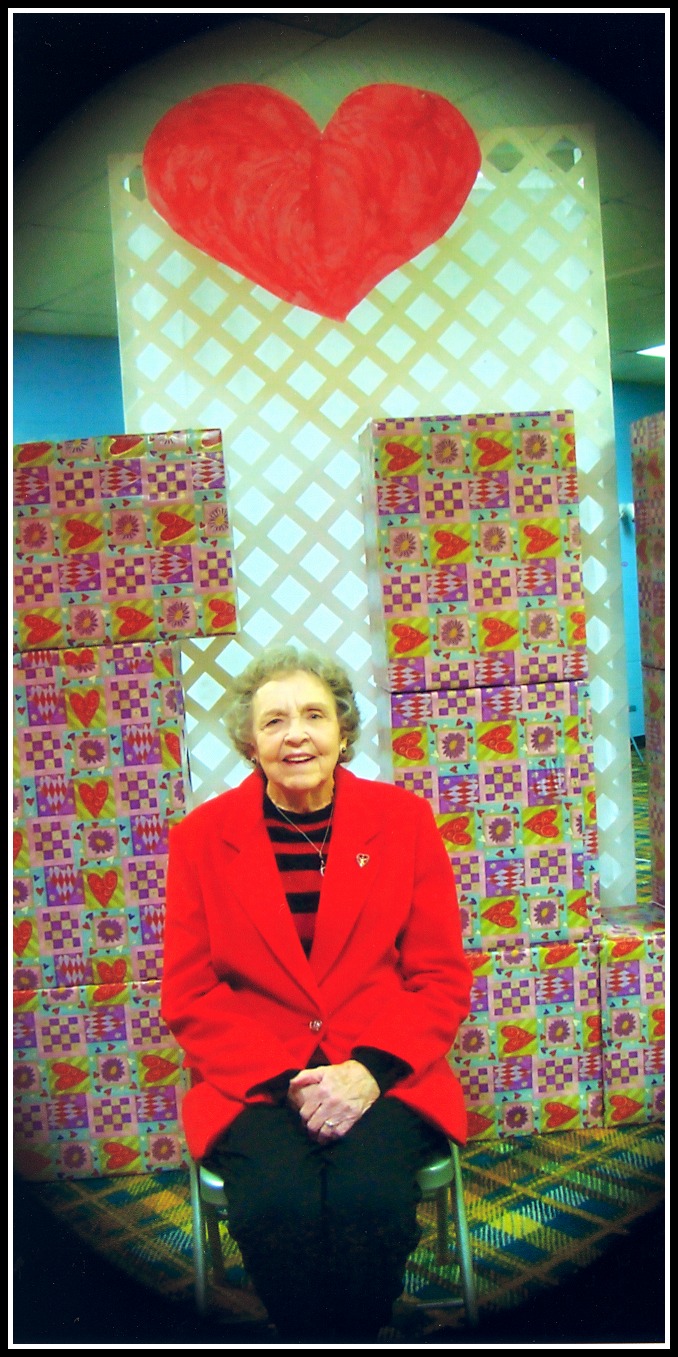
Mom at Church luncheon, Valentine's, Day 2008

Mom at Church luncheon, Valentine’s Day 2008

Certainly, Mom knew she wasn’t a saint—she knew well her shortcomings.  Of course, it’s also true that she didn’t like admitting to them, much less having them pointed out to her.  But then, who does?  In self-defense, she’d sometimes say that except for Jesus, who she firmly believed to be the only begotten Son of God—there was no such thing as a perfect human being (“So there!”).  But then, she also believed that we humans were created in God’s image, and that that meant there was a spark of Godliness in all of us.  And it was our job, then, to fan that spark into a little flame as best we could.  So she tried.  Sometimes her attempts could be awkward and clumsy.  But other times her efforts—her efforts to be more godly—were simple and graceful, and amazing.

Finally, I’d like to say how important Mom’s friends and neighbors, this community, and especially this church were to her.  The Church was right at the center of Mom’s universe.  She loved the Bible Study, the music; she loved participating in the quilting bees, in the bunko gatherings; and she loved the senior citizen “Lamplighter” activities where she got to show off her bread pudding, her casseroles, and her macaroni and cheese.

Mom, circa 1931. Forever young.

Mom, circa 1931. Forever young.

So I think I can speak for the family in saying that it gives us comfort to know that Mom spent the last hours, and literally the last minutes of her life on this earth with her church brothers and sisters.  With people whom she loved.

Thank you all for that.  And thank you for coming out for Mom.

Posted in Uncategorized | Tagged , , , , , , , , , , , , | 12 Comments

Three ‘Free Verses’ (as well they should be!) by @jackaurquhart

Screen Shot 2013-11-26 at 11.43.31 AM

CatLurking

Unforgivable

©2013 by Jack A. Urquhart

Three squirrels feed
On the meager seed
I scatter
Familial, skittish
They chatter and chide

Tattered tails
Unfurled like ship sails
Their backsides
From every angle
Guilelessly exposed

While just there—
Amidst the heather—
A black cat
Crouches stealthily
A pitch dark angel

In silence
From a safe distance
I observe
Knowing full and well
What will happen next

Purple squiggle 14

Screen Shot 2013-11-26 at 11.43.43 AM

WetDream

Wet Dream

©2013 by Jack A. Urquhart

I have a recurrent dream—
a dream of loving you
Together we swim
over sheets warm as beach sand
the ebb and flow of coverlets
thrashing, frothing, periwinkle blue
washes our salted bodies
We are slick with spray
anchored, drowning together
awash in gravity
Had I the weight of the moon
I would will this nightly ritual
steady as the tides

Purple squiggle 14

Screen Shot 2013-11-26 at 11.43.51 AM

SnowChildren

In a dream, I hear my children

©2013 by Jack A. Urquhart

Though they are long gone
in a dream I hear my children
at play again
Their icicle laughter
tinkles ‘round the dormers
of consciousness
chatters at the windowsill
of memory
The ruckus they raise
is winter-green
blizzard sharp
crisp as clean delight
Despairing, I awaken
no doors to slam
no windows to shut
Nothing to mute the cold clarity
the wintered beauty
of a moment lost

Posted in Uncategorized | 3 Comments

A very strange man, by @jackaurquhart

©2013 by Jack A. Urquhart       988 words

300px-LederhoseOnce long ago in another lifetime, I was Vice-President of a multi-million-dollar financial institution.  Until, on a spring afternoon, suddenly I wasn’t.

It was mid May, I believe, when the firm’s majority stockholder—a quirks-a-plenty entrepreneur and amateur mountaineer, whom I’ll refer to here as Mac-C—summoned me to his office for what I thought would be a routine briefing.

Instead, after I’d delivered my weekly report, Mac-C—amidst a shock of facial twitchings and skittish scratchings—informed me (to borrow from the immortal words of Ray Charles) that it was time “to hit the road, Jack.”

I was blindsided.  Shocked to the core.

I remember gathering up my things after what had turned out to be my exit interview thinking that the day couldn’t possibly get worse.

I was wrong.

Later that afternoon, in what seemed an exclamation point to the day’s events, my daughter ‘D’—then age three and fond of experimentation—shoved a peanut up her nose while I wasn’t paying attention.

The several hours spent in the emergency room following this nutty diversion afforded time for silent fulmination. I remember sitting in the waiting room with ‘D’ on my lap fretting over how egregiously I’d been wronged.

Hadn’t the company thrived on my watch?  Hadn’t I devoted years toward mastering industry standards, endured countless sleepless nights familiarizing myself with mind-numbing I.R.S. code?

Had I done all that to be cast aside—by an oaf? A man who hadn’t any better sense than to wear lederhosen to work?  Who sometimes forgot to bathe for several days after one of his back range treks?  Who routinely displayed enough indecorous tics to provide a cadre of neurologists with case study material for a year?

And yet, somehow I couldn’t dismiss the Pandora’s box of shortcomings that Mac-C had thrown open at my feet that afternoon.  The host of hobgoblins he’d summoned for my mortification had been that formidable.  They included the following:

▪   That my professional decisions were too often ego and fear driven;

▪   That, for example, I didn’t delegate properly lest my value and importance to the institution be lessened;

▪   That I was too soft on ‘subordinates’ (his word) and remiss in redressing employee short-comings;

▪   That I was short-sighted, too focused on the day-to-day bottom line;

▪   And finally, that I had no vision for the company because I had none for myself—nothing beyond living up to the conventional standards of middle class life.

Words to that effect.

According to Mac-C, I was going through the motions; dressing myself up in technical expertise, ingratiating myself with co-workers as a kind of diversion from the fact that “you don’t really like this work,” he said, scratching at his crotch.

Dumbfounded, breathless, I listened as Mac-C opined that my career choice, as well as the lifestyle it supported, was—and I believe these were his exact words—“fundamentally unsuited to you.”

Given to loquaciousness, it took the man another half hour to get ‘round to his pièce de résistance:

“My advice in the face of failure,” he said (pausing to employ a particularly disgusting maneuver in clearing his nose), “is that it’s best to get on with something you enjoy—best to live naturally, to be true to yourself.”

Really?

After eight years of service, that was the best he could offer?

I was seething by the time the interview concluded, too choked up to speak, furious that a man so evidently obtuse, so totally oblivious would ever dare to shame and criticize.

Live naturallyBe true to yourself!

What rubbish!

What nerve!

That Mac-C should presume to offer anyone counsel was mind-boggling, I told myself—this doofus, this oddball who for all his wealth and influence routinely made a spectacle of himself.  Who, no matter the context or company, was forever scratching absently at his arse, picking at his nose, burping unabashedly!  As if his actions were beyond notice and reproach.  As if none of us could see.

To say that I felt loathing for Mac-C as I waited in the emergency room with ‘D’ that afternoon would be an understatement.  Yet, holding my daughter’s hand as a gaggle of doctors and nurses worked to extract the recalcitrant peanut, I couldn’t get him out of my head.  Couldn’t even expel a certain picture-perfect portrait of the man.  Again and again as my daughter railed against her doctors’ poking and prodding, the unhappy image flashed through my mind; it was Mac-C, and the way he’d cleared his nose earlier that day—with his index finger blocking one nostril as he huffed and puffed out the other; the entire appalling scenario performed as if it were the most natural thing in the world!

Which was exactly the tactic those harried physicians eventually persuaded daughter ‘D’ to employ in expelling that soggy, swollen peanut.

I have been thinking about Mac-C lately, having recently learned of his death.

His surprisingly lengthy obituary listed a full page of mountain trails conquered, businesses established, organizations and individuals supported and assisted.

I think now that I was one of them.  One of those individuals.

I think now that Mac-C did me a favor:

▪   By exposing my limitations;

▪   By forcing me to own how wrong-headed some of my choices had been, and, more damningly, how craven my motivations in choosing them;

▪   By showing me how ill suited I was for the work—and even the ‘lifestyle’—I’d forced myself to essay.

▪   And by booting me out into the world where I would have to explore other options.

A very strange man, he was.  And uncouth.  But I think now that Mac-C was never so obtuse as I imagined, and certainly never as oblivious.

Live naturally.  Be true to yourself, he counseled me.  So facile.  So profoundly difficult.

And yet, so wise.

I was sorry to learn of his passing.

Sorrier still that I haven’t heeded his advice more consistently.

Posted in Uncategorized | Tagged , , , , , , , , , , , , , , , , , | 5 Comments

As real as ever, by @jackaurquhart

In Memoriam, Dillon Tyler Urquhart, 3.08.1979 – 8.02.2013

©2013 by Jack A. Urquhart  370 words

Dillon waterfront

Dear Dillon, Dear Son,

You are much on my mind today.

It has been 72 days now.  You’d think that would be long enough, wouldn’t you?  Long enough for anyone to settle into reality.  But I’m not quite there yet.

On the contrary, I keep fooling myself that parents don’t outlive their children; over and over, I grasp at that notion, hold on to it for dear life—until the idea of your death seems as unreal as ever.  I tell myself that it must be a terrible mistake, a misunderstanding—your absence.  Nothing more than another bad dream.  Something I imagined?

I do that sometimes, you know—conjure up a scenario so terrible, and in such detail, that it almost seems real?  And then I pull myself back from the brink with a great sigh of relief, thankful that it’s all been a fantasy, just my head getting away from me.

Only this time, I can’t; this time, it isn’t.

This time I can’t pull back from the truth for more than a few scattered hours; a day or two here and there at best.  I can’t take lasting comfort in any hard evidence that refutes imagination.  No matter how hard I work to ignore the space you’ve vacated, it persists, waits to blindside me—usually when I’m thinking the worst is over and that I’m getting stronger.

Just then, some innocuous moment overwhelms:

A young family roughhousing in the park; a new Daddy toting his infant through the mall; a father and son in animated conversation at a local diner, their blood-deep relationship as plain as the nose on your face, as obvious as their before-and-after versions of the same profile.

That is when it all comes home to me—the permanence of your absence:

No more late-night phone calls and texts, no e-mails; never again a laughing lunch as you slurp your way through a steaming bowl of Pho.

Nothing of that Dillon who occasioned so much happiness, and worry, and laughter, and aggravation.  And love.

So.  Much.  Love.

Except in my dreams, where you show up as real as ever.  As real as ever.

Just as real as ever.

Love, Dad

Posted in Uncategorized | Tagged , , , , , , , , , , , , | 6 Comments

Indie Authors: Yakkers, Tweeters, Braggers? Is that all there is to us? by @JackAUrquhart

©2013 by Jack A. Urquhart   2177 words

Though I speak with the tongues of men and of angels, and have not charity, I am become as sounding brass... 1 Corinthians 13:1

Though I speak with the tongues of men and of angels, and have not charity, I am become as sounding brass…
1 Corinthians 13:1

“To me, it seems disrespectful … that a ‘wannabe’ assumes it’s all so easy s/he can put out a ‘published novel’ without bothering to read, study, or do the research … Self-publishing is a short cut and I don’t believe in short cuts when it comes to the arts.Sue Grafton, American author of detective novels (‘Alphabet Series’), LouisvilleKY.com, August 7, 2012
Amazon wants a world in which books are either self-published or published by Amazon itself, with readers dependent on Amazon reviews in choosing books …  The work of yakkers and tweeters and braggers, and of people with the money to pay somebody to churn out hundreds of five-star reviews for them, will flourish in that world.”Jonathan Franzen, American author (The Corrections; Freedom) The Guardian, September 13, 2013

*****

It has taken me a long time (and several failed drafts) to pursue this post on independently published authors.  That is because, even though I am a longtime semi-professional writer (nearly 30 years and counting), the fact is I went Indie only twenty months ago—which means I still have much to learn.

Part of my education, one of the more troubling parts, has been making sense of the bad press aimed at independently published writers, much of it by A-List, traditionally published authors like the two gifted writers whose words introduce this post.

For nearly two years I’ve read the various allegations leveled against us—charges, it seems to me, that can be distilled into a single sentence:

Independently published writers are lazy, unprofessional, short-cut seeking opportunists whose sub-standard products and practices decimate literary culture.

I confess that I am of two minds about these criticisms, my ambivalence rooted in the fact that there is incontrovertible evidence to support some of them.

Indeed, who hasn’t made the mistake of purchasing an abysmally conceived, written, and copyedited Indie novel at least once, or been taken in by an egregiously misleading 5-star Goodreads/Amazon review of an independently published work?  I refer to reviews that, according to several recent exposés (see here and here), have sometimes been bought and paid for, or posted by friends and relatives of the author.

Furthermore, what frequenter of social media—a primary marketing platform for Indies—hasn’t endured the clamor of authors begging Facebook ‘likes’ and/or auto-tweeting sales pitches?

And yet, I can’t help thinking that Indie critics, several of them at least, have overlooked something important, something to do with why some of us—writers who’ve worked at our craft for years, either professionally or as dedicated students of literature—choose to publish independently.  And what’s more, I wonder if several detractors haven’t been disingenuous in their condemnations.

Exploring a few of the most famous Indie criticisms, as well as the suppositions I pose above, is the purpose of this post—I hope toward achieving a more balanced take on Indie writers and what motivates us.

I will pass quickly over charges of Indie product inferiority as there is ample printed evidence to show that traditionally published authors and their big-name publishers have, for centuries, been felling whole forests in the service of bringing ‘pulp’ to market.  (At least in the Indie Universe, which exists mainly in cyberspace, there is less ecological damage, and taking out the ‘trash’ can be as easy as clicking [delete].)

Rather, I think it more useful to focus on what seems an obvious fallacy in an often-cited criticism of Indie authors—that we are lazy, short-cut seeking opportunists (see introductory Grafton quote).  That charge, I believe, is anchored in the bogus notion that mainstream publishing, as practiced today, is a meritocracy—i.e., if you’re good enough, if you persist long enough, you’ll get published.

Nothing could be farther from the truth.

In the real world, it isn’t the most gifted, the most hard-working writer who gains representation, whose work is optioned and/or brought to market.

As top literary agent Wendy Keller (Wendy Keller/Keller Media, Inc. Literary Agency & Speakers Bureau) makes abundantly clear in this online interview, in the publishing trade, rejection is the rule, not the exception.

Her agency, for example, typically receives 500 +/- author queries a month, about 99.5% of which are rejected out of hand.  Furthermore, out of every fifty proposals actually reviewed by Keller’s agency, only one or two makes it to publishers.  Keller goes on to point out that top agents rarely sell more than 3 out of every 5 represented projects.

Statistics like this, which Keller implies apply industry-wide, lay waste the notion of a publishing meritocracy.  Indeed, common sense, as well as the law of averages, would dictate that many talented, perhaps even gifted, writers never make it out of an agent’s slush pile, their efforts thus consigned to that 99.5% rejection heap.

These are discouraging realities, but this Indie author, for one, sees no point in bewailing them.

The fact is, there are only so many customers in the market place, and the number of writers, talented or not, hoping to accommodate their literary tastes (and/or whims) exceeds demand.  Not every writer gets to be, or should be, a bestseller (I’ll leave unaddressed the question of whether some who are deserve to be).  But does that mean that the rest of us should be denied space on bookshelves—in physical or cyber space?

What recourse beyond a possibly endless cycle of rejection letters do we ‘others,’ some of us talented, have?  Are we to storm the bastions of traditional publishing indefinitely?  Stand outside the door while a few hundred gatekeepers—those long-entrenched arbiters of taste, quality, and ‘tradition’—dither over whether to allow us admission?

Are we to ignore ever-evolving trends and options in publishing in order to maintain some holier-than-thou status quo?

I would argue that independent publishing offers a viable, even sensible, alternative to writers who have ‘traditionally’ been left out in the cold.  Perhaps none more so than those serious writers whose fundamental motivation in taking to the keyboard, in taking up pen and paper, is not a matter of choice, but rather necessity—like breathing, eating, and sleeping.  Writers driven by the impetus to communicate, to understand what it means to be alive, and to attempt the creation of something lasting, perhaps even something that approaches ‘art.’  And to have it noticed—even if that notice is limited to 10, or 20, or a few hundred readers.

That is why I decided to publish my short stories independently on my blog and via Amazon’s CreateSpace platform.  From jump street, I knew that the effort was unlikely to make money (it hasn’t); but I believed that any reader feedback I received would be more useful to me as a writer than the form letter and e-mail rejections I’ve received over the years (and it has been).

Traditional publishing a meritocracy?  I don’t think the facts support that notion.

But let’s move on to another criticism aimed at Indie authors, perhaps the most famous of the lot—one that casts us all into a slush pile of ‘Yakkers, Tweeters, and Braggers’.  For this catchy phrase we can thank Jonathan Franzen, author of the National Book Award winning novel, The Corrections, 2001, and more recently, the bestseller, Freedom, 2010.

In his often-cited 5,500+ word Guardian essay, Franzen decries an Amazon-ian literary world order in which

books are either self-published or published by Amazon itself, with readers dependent on Amazon reviews in choosing books, and with authors responsible for their own promotion…”

before going on to make his famous claim that only

“The work of yakkers and tweeters and braggers, and of people with the money to pay somebody to churn out hundreds of five-star reviews for them, will flourish in that world.”

There is truth in some of Franzen’s kvetching.

As previously noted in this post, the speciousness of many Indie reviews posted on Amazon and other online review sites is supported by hard evidence.

And yet, it’s worth mentioning that even mainstream book reviews—in publications no less esteemed than the New York Times—are not beyond suspicion.  Author Zoë Heller (What was she thinking?: Notes on a Scandal), in a recent NYT Sunday Book Review piece, explores the risks of writers reviewing the work of other writers—a practice common in the NYT and most top-tier publications.  It is a practice, which, Heller points out, can pose serious obstacles to objectivity.  Writes Heller,

“When it comes to negative reviews, the disincentives for a novelist or a poet are … obvious.  Write a bad review and you make an enemy for life; no writer ever forgets a pan.  And these days, when so many writers work in the academy, an enemy can be a real threat to one’s career.  Just wait until the victim of your bad review … turns up on your hiring committee or your prize jury.”

But to return to the subject of Indie reviews: in the absence of critical attention from the mainstream media, several online review sites have begun building reputations for fairness.  Self-Publishing Review, IndieReader.com, and Kirkus spring to mind. Unfortunately, most of them charge a fee—$75 to $575—that is too pricey for many Indies.  That said, one would expect, and indeed hope, to see other (less costly?) organizations established as Indie publishing gains ground.  We will have to wait and see—keeping in mind that the phenomenal changes in publishing are fairly recent and still unfolding.

It takes time to build credibility.

As for the complaint that Amazon forces writers to do their own promotion, I would point out that this practice is not limited to Amazon.  In fact, it is already being co-opted by traditional publishers, especially the smaller houses.  For an example, read Trey Ratcliff’s account here of how, after landing an agent and publisher for his photography book, A World in HDR, Ratcliff learned that marketing and promotions would be his responsibility.

But regardless of the role Amazon plays in shaping marketing trends, the fact is, sales and promotions are wedded to publishing—in traditional and Indie universes.  And those with the talent and taste for entrepreneurship will hold an advantage in the market place.

Which brings me (finally!) to the charge that Indie authors cheapen and damage ‘literary culture’ with their yakking, bragging, tweeting approach to marketing.

To that accusation I would begin by asking, what qualifies as yakking and bragging?

Is it an author web site—let’s say, like the one bestselling detective author Sue Grafton maintains?  A site replete with links to interviews, newsletters, journal notes, book promos, and even photographs of Ms. Grafton’s husband, her chef and personal assistant, her cats?

Is it a 5,500+ word Guardian essay/book promo that, in Franzen’s case, holds forth in print on topics as diverse as Austrian satirist Karl Kraus (the subject of Franzen’s new book, The Kraus Project), Amazon’s Jeff Bezos, Apple versus PC television commercials, the transformation of Canada’s boreal forests, and even low-cost porch furniture on sale at Home Depot?

As for all that annoying Indie Tweeting, I’d be surprised if someone hasn’t already pointed out that it would take some 270+ Twitter tweets to match the 38,000 characters (letters, punctuation points and spaces) in Franzen’s above-referenced Guardian essay, which is but one of dozens of online articles, interviews, reviews, and quotes devoted to the bestselling author.

I cite these examples not to criticize Grafton or Franzen for taking advantage of the promotional opportunities available to them.  Nor do I mean to imply that by exercising those opportunities they’ve been guilty of yakking and/or braggadocio (perhaps loquaciousness, a wee bit of showiness?).  Rather, I mean to suggest that it seems unreasonable to decry and demean Indie authors en masse for making use of the limited media opportunities available to them, unfair to begrudge us our piddling sales tweets and Facebook ‘likes,’ however annoying they may be.

So there!

As for this Indie writer (and in merciful conclusion), allow me to add that I have long since adjusted my authorial aspirations to the realities of the marketplace—and my personality.  The simple truth is, not everyone will write bestsellers and not everyone has the talent for self-promotion (apparently my horn-tooting gene is recessive).  Some of us must settle for a smaller readership—perhaps very small; readers cultivated via our blogs, by means of self-published essays, short stories and novels—and yes, even via Twitter.

Some of us may yet hit it big.  Others, not so much.

I can live with that.

I can because I believe that for myself and for many others driven to write and publish independently, our reasons outweigh issues of ego and sales figures, dollars and cents (most of us earn less that $500 a year)—not that those motives are necessarily unseemly.  But there is more to us than that.  There is something that impels us to the intellectual, emotional, and physical exercise of writing.  Something about the quest for clarity and connection that urges us to the task.

And what good is all that effort if we don’t make use of viable options for sharing it?

 

Posted in Uncategorized | Tagged , , , , , , , , , , , , , , , , , , , , , , , , , , , , , | 9 Comments

A Rocky Mountain Lullaby (For Dillon), by @jackaurquhart

Gods little mascot©2013 by Jack A. Urquhart     (1115 words)

September 17, 2013

Dear Dillon, Dear Son,

I have been thinking about your early years, trying to remember some of the salient moments of your childhood, events that seem conspicuous in terms of our relationship.  Of course, my take on these long-gone years is subject to the pitfalls that plague any would-be historian: the human tendency to airbrush the facts (Lord, how we want things neat and tidy!), to substitute supposition for detail gone AWOL, the temptation to steer our recollections along a biased trajectory.

I plead guilty on all counts.

Even so, I am compelled to attempt your story, albeit in vignettes.  That is because I miss you more than you can know.  Literally.  And now that you’ve gone where smartphones are useless, I find any effort (even a faulty narrative) that brings you back to mind lessens the sometimes overwhelming sense of separation I feel.  And isn’t that ironic, given an entire continent lay between us at the end.

But tonight I want to remember a closer time.  I want to remember you as a toddler—or rather, an incident from that era.  I want to recall how determined you were to work your will.

So … here is a memory, an episode in the story of Dillon Tyler Urquhart; maybe you recollect it too?  And from a more advantageous angle?

The family is living on Mallory Street in Lafayette, Colorado.  It is our first real home, your Mom’s and mine, and you are our first, our only child, as your sister Devon’s birth is yet months away.  You are three years old, Dillon, and heart-stoppingly beautiful—and truth be told, a sometimes pain in the ass.

At nap time, for instance.

Indeed, the idea of a mid-afternoon snooze is anathema to you.  God forbid anything should separate you from Mom or Dad for more than a few minutes at a time.

All morning, you play cherub on a baby-blue cloud; but come 2:00 p.m., you turn Devil, bring out the big guns—the cranky, screeching, red hot fire and brimstone tantrums.

Dillon, I don’t know how you manage it.  Oy!  Such an infernal ruckus from a little tyke!  Such howlings as one imagines from the depths of Hell!  Only imagination isn’t necessary on Mallory Street—not at nap time.  Hell is right here on Earth.  And it’s been this way for months.

Your mother and I have tried everything: consistent sleep schedules to establish a set routine, back rubs as you lay a-crib to calm you toward sleep, favorite crib safe toys tucked in with you.  We check in at ten minute intervals as you lay shrieking to show you’ve not been abandoned.  And God help us, we even try reasoning with you:

“It’s important you get rested up, Dill.  That way you’ll have more energy for playtime later.”

Nothing works.  In fact, things go from bad to worse.

It is just a matter of time before the neighbors, alarmed by your daily screams, take steps.  This is Boulder County, after all—bastion of sensible, compassionate child rearing practices; citadel of Doctor Spock pediatrics.  No, not the guy from Vulcan!

In plain English, this is ‘no-spank territory’.

All this by way of saying that outside intervention is inevitable.

It comes knocking at Mallory Street on a frosty Sunday afternoon—civic concern in the person of a formidable Policeman.  Indeed, ‘Officer Burly’ all but fills the doorway and he wastes no time informing your bedraggled parents that a report of possible child abuse has been lodged.  I think you must be listening from your crib, because right on cue, you oblige with an ear-splitting screech.

I can’t help it, Dill: I laugh outright, inquire if it’s possible to lodge a complaint of parent abuse, invite the officer to inspect first hand the source of all the commotion.

Of course, the moment Officer Burly approaches your crib, removes you for a closer look, you are all sweetness and light, nary a whimper.  H-e-l-l-o Dillon, heaven’s little mascot!

A five-minute inspection and you are pronounced safe—fit for future tantrums.  But luck is with your Mom and me today, for Officer ‘B’ is something of a child psychologist himself.  A pop psychologist.  Literally.

“Have you tried top forty?” he inquires. “My daughter was a screamer.  Neil Diamond did the trick.  She liked a catchy refrain: Sweet Car-o-line, nah-nah-nah,” Officer ‘B’ warbles.  “Must’ve played that track a thousand times before she was four.  Kids like simple rhythms.  They like repetition.  Something that’s always the same.”

You don’t say?

Talk about a godsend.  That’s Officer ‘B’.

And John Denver—aka Henry John Deutschendorf, Jr.

It was his “Rocky Mountain High” did it for you, Dill—that and “Leaving on a Jet Plane.”  Those tunes on eight-track were lullabies to hours of blissful sleep.  There must have been something in Mister Deutschendorf’s soaring, beautiful voice.  Something as reassuring and as permanent as the Rockies?

Which brings me back to where I started, Dill.  For it’s clear to me that there really is something to that old saw, “like father, like son”; for our relationship even in those early days was, I think, a struggle of strong wills.  A struggle that lasted to the end of your too short life, Dear Boy; a campaign that pitted your need for a familial always accessible safety net against your Daddy’s determination you should acquire the confidence that springs from self-reliance, from knowing you could stand alone when necessary.

So I didn’t want to get too close once you ventured out on your own.  I didn’t want to stand next to your struggles lest you reach for the ‘net’ unnecessarily.  And, in truth, I didn’t want the mess, the pain of witnessing firsthand the inevitable suffering that comes with growing up.

That was perhaps unpardonably selfish of me—and a terrible mistake.  A mistake not to have offered more freely and more often the comfort of something Rocky Mountain solid.  Something that might’ve soothed your sleepless nights in those final illness-plagued months.  Something more than phone calls and letters.

And although it is too late now, too late to bring you back, I send these few words into the ether, along with a few of Mr. Deutschendorf’s finest, against the hope that they will find you.  And help you rest.

His sight is turned inside himself, to try and understand
the serenity of a clear blue mountain lake.

And the Colorado Rocky Mountain high, I’ve seen it raining fire in the sky.
You can talk to God and listen to the casual reply.
Rocky Mountain high, Colorado. Rocky Mountain high.

Sleep tight, Beautiful Boy.  Sweet dreams, Dear Son.

Love,

Dad
xox

Posted in Uncategorized | Tagged , , , , , , , , , , , , , , , | 12 Comments

One Month, by @jackaurquhart

©2013 by Jack A. Urquhart, 680 words

Dill One Month 2September 2, 2013

Dear Dillon, Dear Son,

It is one month today since you left us, since you died in a Seattle hospital with your mother and I standing at your bedside.  Oh Dill, I wish I could express how much your absence still feels unreal—even though your ashes are in the next room as I write this.  Even though I keep close the few mementos you left: your I.D. card carried in my wallet; your baseball cap worn when I work in the garden; your photos on my cell phone and computer.  Even the photos taken in your hospital room on that final dreadful day.

Perhaps this reliance on keepsakes seems strange.  But so is grief—all the feelings that impel one, or at least this one—to keep revisiting the past.  As if that could ever mitigate the loss.

And yet, I keep trying.

The thing is, Dill, I linger over these tokens—yes, even the photos taken as you lay dying—not out of morbid obsession, not because I’m afraid I’ll forget your face; but because I want to re-live your beauty.  It’s right there, you know—even in those deathbed shots.  That is because it looks like you’ve just fallen asleep!  I swear, I can see your childhood-self shining through in that hospital bed.  The little boy (who was often such a pill) is sleeping there in the grown man!  I see his gorgeous eyes, so perfectly almond-shaped and long-lashed in slumber.  I see little Dill’s pursed and budding lips, his hair sweeping back in dark moist strands.  And your beautiful hands—an artist’s hands—that are so like your sister’s, your Mom’s.

So I look again and again because I don’t want to believe that I’ll never see you again—the child or the man.  Not in life, anyway.  I don’t want to accept that.  Not yet.  And I look because that’s all I’ve been able to do.

Until today.

Today, I found the courage to listen.

Today I played it again—your last voicemail, saved on my cell phone.

The date stamp is July 5, 2013, 9:11 a.m.  You had only 28 days to live.  I wonder if you sensed as much—if you’d guessed that time might be running out.  Along with everything else, I wonder if there wasn’t some glimmer of foreknowledge in the slow repetitive gravity of your speech patterns, in each heavy, disconsolate pause.

Oh Dill!  You can’t know how sorry I am to have missed that call.

Here is what you said:

“Hey Dad, it’s me. Um—Just calling to let you know—um—I made it out of the hospital.  I’m at the—um—Solutions Center. Um—I’m trying to find some solutions now and, um—just trying to get in, back involved with family.  I just really miss, I really miss a lot, a lot of the times that, that, that we’ve had together; that, that you and I have had together, but—um—well, anyway.  I’ll call.  I’ll call you back later today.  All right—Love you Dad.  Bye.”

Dillon, I don’t remember if we talked after that day.  Surely we must have.  But I can’t be certain.  I can’t say for sure that that recording wasn’t your last goodbye.  And I can’t remember if I had the chance afterward to say something to make you feel more connected.  Less lonely.  Something—anything—powerful enough to silence even briefly the voices in your head; some few words that would help you to feel less afraid, more secure of your place in our family.  In this world.  Something beyond the cliché—so that you would know that you belonged.

Dear God, I hope I did.  I hope I gave you (at least!) a last blessing.  Something as precious as the one you telephoned to me on that July morning eight weeks ago.  Thank you for that.

But just in case I forgot to say so back then, and against the possibility that you might still be listening, I offer this one:

Love you, Dill.  Always.  Forever.

Dad
xox

Posted in Uncategorized | Tagged , , , , , , , , , , , | 5 Comments

Word Wishes for Dillon, Wherever He May Be … by @jackaurquhart

©2013                                       390 words

“Oh, earth, you’re too wonderful for anybody to realize you.  Do any human beings ever realize life while they live it—every, every minute?”

Thornton Wilder (“Our Town”)

Dillon Tyler Urquhart, 1979--2013

Dillon Tyler Urquhart, 1979–2013

Dear Dillon; Dear Son,

I have always believed that words have power—the power to traverse great distances, the power to break or heal the human heart.  That is why, despite the events of last week, the dream from which there seems to be no waking, I set these few symbols loose in the ether hoping that I’ve not been mistaken all these years.  Hoping that somehow, some way, the meaning embedded in these modern-day digital hieroglyphics will find you where you are.  Wherever that may be.  And that they will bring solace.  To us both.

Dillon, I want you to know how profoundly you are loved.  Still.  And how many times we have all—your sister and Mom; your friends; your Daddy—wished you back again.  I want you to know how we’ve wished that the people who passed you in that Seattle park where you lay unconscious last Saturday could have recognized you as someone’s dear child—the longed-for consequence of your parents’ love, of all our hopes and dreams.  Not a nameless throwaway street person.  And I wish that you’d not been there at all, that the illness that caused you so much suffering over the years had not driven you to that desperate place.  And yes, Dillon, I want you to know that I wish I had done more to keep that from happening.  Because the father in me knows that there was.  More, that is.  Always more that could be done.  So I wish for your forgiveness, too.

But most of all I wish you to know what a privilege it was to be there when you took your first breath—and your last.  I wish you to know, as a dear friend has so eloquently written, that despite “the grooves of anxiety and worry that spun the record of [our] relationship…” I count it a gift to have been—to be—your Dad, and that I wish you whole and free at last from suffering, having awakened in some happier place.  And that if life is truly but a dream, then I wish someday to rouse there too.  And find you waiting.

Love,

Dad

Posted in Uncategorized | Tagged , , , , , , , , , , , , , , , , , , , | 4 Comments

Lost or Found, Relative or Fake: My brush with Indigence, by @JackAUrquhart

New Twenty Dollar bill

©2013  980 words

There has never been a time when I didn’t worry about money.

I write that sentence understanding full well that I know nothing of abject poverty.  Indeed, pecuniary anxieties, when they’ve come my way, have been the ordinary middle-class variety.  Non-life threatening.

In my youth those worries were about supplementing the minimal allowance that my parents were occasionally able to afford—about raising money to pay for a Saturday afternoon movie, a new pair of track and field shoes, things my more affluent schoolmates didn’t give a second thought.  Later, as a young man unskilled in money management, my troubles sprang from foolish choices—how to make rent and pay college loans after having spent too much on good times.  Later still, after I’d become a husband and father, monetary challenges were more domestic in nature: how to afford sky-high childcare, what to do about a furnace in need of repair.

Now that I’ve entered my so-called golden years (though I think the reference to ‘gold’ in that tired old cliché greatly exaggerated), my partner and I keep ends met without much difficulty, even on fixed incomes.  That said, there are still those nights when my sleepless mind gets carried away by worst-case scenarios—all the ‘what ifs’: What if a serious illness strikes?  What if an aging parent needs help?  What if Social Security turns out to be a ruse?

I reiterate that the cares I’ve enumerated don’t add up to a hill of beans against the unscalable Mount Everest of worldwide poverty.  Not when, as I read a few weeks back, 50% of the planet’s 7 billion+ human beings live on less than $2.50 a day.

In a world where such statistics rule my petty economic concerns don’t count for much.  I know that I’m privileged.

Even three years ago when my partner and I lost our California home in the great U.S. bursting real estate bubble, we never lived hand-to-mouth; we never worried we’d be on the street.  That’s how fortunate we were; how fortunate I’ve always been.  Losses happen—a job, a home, savings—my life stumbles on.

Of course, it could be argued that all losses—even those that First World’ers like myself encounter—are relative in the great scheme of things.  In fact, lately I’ve been struck by how even a small loss can assume unexpected proportions—relatively speaking.

For example, a few weeks back, I lost some cash.  Somewhere between the downtown ATM and my home, the money went missing.  I remember looking for it in the usual places—for all of a few minutes.  It never occurred to me then that my loss could have—for a full day—made the difference between hunger and satiation for 8 of the planet’s impoverished inhabitants.  I didn’t consider that, until last Friday—until I’d experienced a brush with indigence.

Here’s how it went down.

On Fridays I go to the gym at 5:00 a.m.  Afterward, my reward (for all that pain and suffering) is a trip to Starbucks.  Only last Friday, my routine was interrupted.  There on the sidewalk outside my gym I encountered a family, the mother and daughter seated curbside while Dad fed coins into a nearby pay phone.  Both bedraggled parents looked to be in their early thirties; their little girl, perhaps six or seven.  It was 6:30 a.m.  Early for a young family to be on the street.

As I approached, the Dad, pointing at his wristwatch, hailed me.  I thought him inquiring after the time.  Instead, he asked if I could direct him to the nearest pawn shop.  But before I could respond that none of them would be open at this hour, he’d begun relating his family’s situation.  He’d just begun a new job, he explained in a breathless, embarrassed rush; however, payday was 3 days away.  Meanwhile, he said, his voice breaking, the family hadn’t enough cash to cover their temporary accommodations at a nearby motel.  Unless his wristwatch could fetch $20.00 at pawn, they’d be on the street.  It took less than half-a-minute for the man to tell the tale.

I remember that at some point during his embarrassed, tearful monologue, I began digging in my pocket for my car keys, thinking—I’ll admit it!—that I had a legitimate ‘out,’ a way to sidestep the awkward encounter.  You see, I don’t carry my wallet on gym mornings—only my driver’s license and a Starbucks card.  But as I went fishing for my keys that morning, I found something else.  I found a twenty-dollar bill in my pocket—right where I’d ‘lost’ it.

There was nothing grand or magnanimous in what happened next.  Rather, the act of retrieving the money and handing it over to that bereft father was a reflex, automatic—like discovering something in the Lost and Found and handing it over to its rightful owner.  The same as anyone would do.

I don’t rightly recall the father’s response, though I know he called his gratitude after me as I hurried on to my car—something about hope.

I do remember that, sitting in my car in the aftermath, I didn’t feel noble.  I didn’t feel proud or generous or righteous.  Rather, I felt confused, even ashamed—ashamed that I’d considered sidestepping the situation.  But mainly, I felt shaken from my comfort zone.

In retrospect, I know that it’s possible I was scammed, that the man’s tears were part of a carefully rehearsed act.  But I don’t know that it matters—not relative to those few shaky moments following the encounter.  Not in comparison to the realization that twenty dollars could assume such momentous proportions, that a loss I’d dismissed could determine—if only for a day—whether there was shelter or no, whether humiliation would rule or a shred of human dignity be preserved.  Whether hope would be lost or found.

Given the world we live in, I can’t help thinking there is nothing relative or fake about any of that.

Posted in Uncategorized | Tagged , , , , , , , | 5 Comments

A Letter to 5 Cowardly U.S. Senators, by @JackAUrquhart

April 18, 2013

Forgotten Future

Forgotten Future (Photo credit: much0)

Honorable Max Baucus (D-Montana)
Honorable Mark Begich (D-Alaska)
Honorable Heidi Heitkamp (D-North Dakota)
Honorable Mark Pryor (D-Arkansas)
Honorable Marco Rubio (R-Florida)
United States Senate,
Washington, DC

Senators,

I am writing to express my disappointment, indeed, my sorrow, that you could not find the courage to support expanded background checks for gun buyers in yesterday’s Senate vote—even though polls show that 90+% of Americans favor them.  I fear that you and the forty other senators who voted against this sensible measure to reduce gun violence have paved the way for more mass shootings—more Newtowns, more Auroras, more Tucsons, and more Virginia Techs.  Furthermore, I believe that your collective votes have exacerbated the notion that members of Congress are excessively beholden to (and cowed by) the gun industry and its various dependent special interest groups, like the National Rifle Association.  How sad that you have allowed the profit-driven and extremist priorities of these entities to trump the cause of public safety.

Please know that although I am a lifelong Democrat, I will henceforth engage with legitimate political action groups—such as Gabrielle Giffords’ Americans for Responsible Solutions, Mayor Michael Bloomberg’s Mayors Against Illegal Guns, and The Brady Campaign to Prevent Gun Violence—toward defeating members of Congress (be they Democrat, Republican, or Independent) who, as today’s New York Times editorial so aptly put it, seem to think that:

“…the carnage at Sandy Hook Elementary School is a forgotten tragedy.  The toll of 270 Americans who are shot every day is not a problem requiring action.  The easy access to guns on the Internet, and the inevitability of the next massacre, is not worth preventing.”

In closing, I can only echo the sentiments of Patricia Maisch, who survived the 2011 mass shooting in Tucson, and shouted her dismay from the gallery after yesterday’s Senate vote; indeed, the outcome of that vote was truly shameful.

Sincerely,

Jack A. Urquhart
Mount Dora, Florida

*****
Dear Blog Readers: You can find contact information for your Congressperson here (U.S. Senate) and here (U.S. House of Representatives).  If you have not already done so, I urge you to contact your Congresspersons and to share with them your beliefs (whatever they are) on gun violence as a vital issue of public safety.

Posted in Uncategorized | Tagged , , , , , , , , , , , , , , , , , , , , , , , , , , , , , , | 3 Comments