A Daddy’s Day Dispatch

By Jack A. Urquhart  ©2012  (1100 words)

Dear Dillon and Devon,

I’ve never cared for Hallmark holidays the likes of Father’s Day—never thought there was much cause for receiving tokens of appreciation from my children for discharging my parental responsibilities.  After all, you didn’t ask to be born.  Rather, your mother and I made that choice—we brought you both in love into a world that is at best unevenly disposed to kindness, and where struggle is for most of us a quotidian enterprise.  Indeed, I expect you, my all-grown-up kiddies, could make an argument that I should be thanking you for having enriched my life.

It is with that thought in mind, and with Father’s Day fast approaching, that I choose to reverse the accepted order of things this year by serving up this little ditty of memorabilia.  I offer it freely to you—and to any others who care to eavesdrop (you are welcome here!).  It’s not much of a Father’s Day gift.  Merely a sampling of this Daddy’s memories offered in token of my ongoing love and devotion.

Beginnings are a good place to start, don’t you think? And birthdays?  Those memories linger brightly in my mind.

They say first born children often take longer coming into the world, and Dillon, that was certainly true of you.  For the longest time—14 hours and then some—you couldn’t decide:  would it be Wednesday or Thursday?  It took a suction cap, applied to the crown of your diffident little noggin to get the show rolling.  You arrived—scarlet, wrinkled, histrionic to the high heavens—on March 8th, 4:44 p.m.  It was snowing in Boulder, Colorado, that afternoon—a cold, wet, spring snow swooping down off the Flatirons, the flakes clumping into cotton ball clusters.

My first parental role was to bathe and dress you—a task like trying to swaddle a greased sausage.  As I struggled to master the art of diapering, the attending nurse cautioned that I should be on my guard  “in case your little man decides to squirt”—a prophecy which you quickly fulfilled.  I remember that your PJs featured little blue and yellow choo-choo trains.  And, of course, there is the memory of your Mom, luminous after her long ordeal, laughing, crying, arms eagerly outstretched to receive you when I brought you to her room.

Three years later, your sister Devon was in a much bigger hurry.

You allowed barely three hours, my Dear, between your first timid stirrings and a confident, unceremonious grand entrance, 12:21 p.m., September 21st .  It was a Tuesday, and from the beginning you were quiet and observant—barely even whimpering in the delivery room.  Even then, you were gorgeous: ruddy from head to toe with whorls of black hair and lips that would’ve put Angelina Jolie’s to shame.  Like your brother before you, I bathed and groomed you for your first family reunion.  I don’t remember your first outfit, Devon, but I do remember how you behaved when I placed you in your mother’s arms, the way you pursed and puckered your lips, as if you were blowing kisses, until you found your mother’s breast.  Nobody had to coax you—you knew just what to do.  Your brother was present as well—the two of you regarding each other askance from opposite sides of the hospital room.

Other memories:  I recall you, Dillon, at eight years, irritable during one of our family hikes in the Sangre de Cristos near Ouray, Colorado.  It was a beautiful summer day, the four of us heading home on the downhill trail, your mother and I dog tired, when you, impatient with the family’s slow pace, decided to go it alone.  I remember, Dill, how, despite multitudinous parental warnings, you went scuttling ever farther ahead, certain that your mother and I would be too exhausted to intervene.  It couldn’t have been more than ten minutes after you disappeared from view when your frightened cries came echoing up the trailhead.  I remember a moment of hackle-raising terror—thinking bears, thinking mountain lions—as I went racing downhill in a guilty panic.  There were so many side trails.  One after another I searched them, desperate to find you, determined when at last I had you locked in my arms, howling like a banshee, that you’d be grounded until your 21st birthday—a punishment I fully intended to implement—as soon as I could bear to let go of you, as soon as I could stop nuzzling the top of your head, dear stubborn, irreplaceable, devastatingly beautiful little boy.

Children have a way of augmenting your worst days in a manner that rings back ridiculous—and endearing—years later.  As on the day that you, Devon, at age 4, decided it might be fun to shove a peanut up your nose.  In fairness, daughter Dear, how were you to know that I would add to the merriment by choosing that same day to inform my boss that I thought him a bona fide arse—a pronouncement that while immensely satisfying (not to mention, accurate) was enough to get me canned.

Two hours we were at the emergency room that afternoon, the whole family—your mother and I wondering if the insurance provided by my now former employer would cover the expense of extricating that recalcitrant nut from your dainty schnoz.  Meanwhile, you and your brother played in the hallway as if all the troubles of the world amounted to naught.  Eventually it took a team of nurses, aided by your mother and I, to corral you for the attempted extraction.  And then you made us all look like fools.  I shall never forget, Devon, your powerful sneeze and the sight of that snotty missile all but launched into orbit.  Later that evening, you asked for the comforting rhythms and repetitions of Dr. Seuss and fell asleep while making your own rhymes in sighs and saws against my chest.

I could go on wandering down memory lane, kids, but I won’t.  Instead I’ll offer this final bit of hard-earned Father’s Day advice—offer it to you, my children, and to any other interested parties in attendance.  Here it is:

Sometimes (often?) the most priceless moments between parent and child—between any two individuals—barely register in real time. 

That is because we Dads and Moms—we human beings—are too busy, too distracted, too tired, and/or too selfish to recognize and appreciate them: the wonders transpiring right under our noses.  Yet, inevitably, these casualties of inattention come back to haunt us, their visitations triggered by old photographs, by bizarrely altered dreams, by family stories told and retold.  They come back to remind us of times lost.

This little fact of life, my Dears, is my Daddy’s Day gift to you.  I offer it in the hope that you might profit from my oversights and omissions.  In the hope that you, better than I, might savor all the little miracles that come your way—as much in the present tense as in the past.

Yours with love,

Dad

Posted in Uncategorized | 5 Comments

Book Review: Peter Marshall Bell’s “Nocturne”; celebrating personhood and lives intertwined.

By Jack A. Urquhart, ©2012 (1000 words)

Full Disclosure: When my spouse Raymond L. Boyington undertook the editorial role in bringing his former partner’s work to print posthumously, I had not expected to play a role in promoting the finished product.  I had read previously a few of the poems penned by Peter Marshall Bell, who died in 1994, but never any of his heretofore unpublished fiction.  Indeed, save for a minor role in translating one of Bell’s stories from the original French to English, I thought it best to keep my distance from a project that was deeply and privately motivated.  In short, I did not wish to intrude on the editor’s labor of love.

All that resolve vanished when I sat down to read Invitation to the Voyage, the Selected Poems of Peter Marshall Bell, and more recently, Nocturne, the slim volume of his nine stories.  I confess this latter enterprise left me reeling with a sense of loss.  That is because on every page was the evidence of a talented writer evolving toward distinction—an advancement in artistry that continued literally to within a few whispers of Bell’s untimely death from the complications of AIDS at age thirty-five.  Indeed, part of the pleasure and the sadness in reading Nocturne lies in witnessing the progression of Bell’s talent (the nine stories are presented in chronological order, 1979—1990).

The author’s early tales, most notably “The End of Tribute,” “Nocturne,” and “The Enemy,” introduce Bell’s lifelong thematic obsession: the human struggle toward wholeness and personhood, a battle that for many—gay and straight alike—pits a survivor’s instinct against the forces of an externally motivated self-hatred.  It is a struggle that presents formidable and particular challenges for the homosexual and latent homosexual protagonists peopling Bell’s fiction.

Interestingly, the early stories sometimes mirror the author’s own history of personal and familial strife.  Witness Bell’s story “The End of Tribute,” in which Walter, the gay protagonist engaged on a Sunday afternoon tour of Paris’s Père Lachaise Cemetery (Bell lived in Paris, 1985-86), is inspired to consider his own losses while standing at the grave of the American rock star, Jim Morrison.  Reflecting on the lyrics of Morrison’s classic Vietnam era anthem, “Riders on the Storm,” Walter muses on his rebellious sister’s untimely death (Bell’s own sister died quite young)—and the resulting familial fallout:

“Oh, sister!  She had been the only one in the family who rallied to that music’s cry.  She had angered her family by rejecting accepted American values like fighting in Vietnam.  Now she was dead.

“I hated her,” his older brother had told him, years after … and although they’d drunk plenty of scotch before Ed let this out, Walter realized … a brother hated his sister in defense of his America.  Let him have his America, Walter thought angrily.  Standing before that grave, he knew his sister had been right.”

In the collection’s title story, “Nocturne,” Bell’s thematics find expression in a child’s early recognition of unacceptable difference amply cued by parental disappointment.  Perhaps drawing on personal experience, the author offers almost a case study of how children may internalize and process—usually at the expense of their psychological well being—a steady diet of subtle and not-so-subtle censure.  In “Nocturne,” the resulting damage is manifested (initially) in secrecy and insomnia:

“The important thing was not to be discovered.  His insomnia was his secret world—the fear that kept him awake was unknown to all those around him… He especially feared the derision and admonition of his father, who would only interpret his insomnia as a sign of cowardice and weakness.  “Like a little girl,” he imagined his father commenting with a sneer.”

Indeed, the impetus to avoid discovery drives several of Bell’s protagonists to self-harm—as in “The Enemy,” where two men, complete strangers from opposite sides of a war zone, meet, and manage to bridge their political and cultural chasms in a few moments of almost romantic sexual congress—before one of them self destructs.

These early stories by Bell, an untrained writer whose natural storytelling gifts appear to have been honed through years of rigorous intellectual pursuit and curiosity, showcase a writer’s steady progress toward proficiency, understanding (of the human condition) and a command of language (several languages in Bell’s case).  It is an evolution that reaches its apex, in my opinion, in Bell’s final four stories.  My particular favorite is the wonderfully full-bodied “We Have Always Been the Same Person”.

That the term ‘full-bodied’ should so perfectly apply to a ‘ghost story’ is one of the delightful ironies of Bell’s mature fiction.  For in this tale, the author weaves a richly atmospheric sojourn reminiscent of Henry James—but without the Gordian sentence structure.

Set in the French coastal city of Dinard, Bell’s literary excursion comes complete with haunted hotel, mysterious portrait, and a helpful female spirit named Louise who favors fireside chats that sound very much like a session in psychotherapy.

“Dear Charles,” she said softly.  “I am not trying to do anything here.  We are simply fulfilling our destinies…

I thought this over and realized that Louise was right, and yet still responded irritably.  “I’m not used to having someone around who’s able to see through me.”

Louise smiled slightly.  “Perhaps it’s a level of intimacy you’re not used to.”  She left the window and took the seat next to mine.  “Charles, I’m really not here to vex you.  If I serve any purpose for you, it is as a mirror of your own conscience.”

Like most of Bell’s fiction, “We have always been the same person” does not present a definite conclusion so much as open the door on several possibilities.  In this case, I prefer to think that Charles, the story’s narrator, will—like the story’s author—eventually find safety, self-acceptance.  Love.

And if I may indulge in one final moment of personal reflection, it is strange for me to consider how my life would have unfolded along a different trajectory had Peter Bell’s not been so tragically curtailed.  Stranger still to consider how the lives, perhaps even the spirits, of people who usually never meet face-to-face—an author and his or her readers—become inexorably intertwined through literature.  Such is the wonder and the mystery of the human quest to create and experience art.  That seems to me a good enough reason to play this small role in sharing and celebrating Peter Bell’s Nocturne—in which his spirit and his artistry remain very much alive.  Page after page.

Posted in Uncategorized | 1 Comment

Book Review: Karen Russell’s “Swamplandia!”; A flavorful dish of gators and ghosts

By Jack A. Urquhart, ©2012 (725 words)

Karen Russell, the gifted author of the debut novel Swamplandia!, has been making quite a name for herself the last few years.  In 2009 she received a 5 Under 35 award from the National Book Foundation and last year she made The New Yorker’s 20 Under 40 list.  And yet, a first taste of her Pulitzer-nominated novel Swamplandia! might seem to suggest a brackish cup of bog water to readers whose conventionally refined palates do not bend toward bizarre ingredients.

What constitutes bizarre in Russell’s literary world?

Consider the Sawtooths, a family of lily-white Ohioans pretending to Native American tribe status (The Big Trees) on their backwater island in the swamps of South Florida.  The Sawtooths, who run the second-rate, failing tourist attraction referenced in the novel’s title, join the growing list of eccentric family-centric best sellers of the last year (Kevin Wilson’s wonderful The Family Fang springs to mind).  But indeed, one would be hard pressed to find a stranger concoction of weirdos than Russell’s alligator wrestling, Ouija board reading Big Trees—and that is before she throws in a balding bear named Judy Garland, a bird man whose expertise is crow removal, and an amorous ghost named Louis Thanksgiving.

Granted, the mix sounds like a dish best enjoyed by readers with an acquired taste for the outré, and in less skilled hands that might be true.  But Russell is an extraordinarily talented literary chef who seasons her Sawtooth saga with a smattering of suspense, a soupçon of eccentric comedy, and a dash of myth that is at all times hauntingly engaging—and even enthralling.

The author’s recipe for success starts with bringing the Sawtooth children forward as her central protagonists.  The trio, two sisters and a brother, take center stage after the cancer-related death of their mother, Hilola, formerly Swamplandia’s star attraction.

There is Ava, an eleven year old alligator wrestler in training who aspires to replace her mother as Swampladia’s main attraction, her sixteen year old sister Osceola whose boyfriend just happens to be a ghost named Louis Thanksgiving, and their eighteen year old brother Kiwi, whose common sense leads him to flee Swamplandia for a rival theme park, but whose lack of social skills seems at times to suggest Asperger’s syndrome.  Any one of the three could easily carry an entire novel, but in Swamplandia! Russell stirs them in one at a time alternating her point of view regularly to tease the reader’s appetite for turning pages.

Ava, the novel’s only first-person narrator (her siblings’ stories unfold in third-person), is the roux that holds Russell’s story together.  When her sister Osceola elopes into the Hellish deep swamp (the notion of a mythic Hell runs rampant all through the novel) with her fiancé, the ardent and very much deceased Louis Thanksgiving, Ava sets out on a risky rescue mission that alternates a child’s desperate and at times comically private myth-making with just enough danger to keep the reader on tenterhooks.

By novel’s end, Kiwi, who has become a star attraction in his own right at a more successful theme park (the aptly named ‘World of Darkness,’ where customers are called ‘Lost Souls’ and enjoy attractions the likes of the ‘Vesuvius Blast Off’ while chowing down on Hellishly hot ‘Dante’s Tamales’) joins his sister in her mission of rescue.  In the interim, Ms. Russell spins a family story that seems determined to keep readers wondering what (in Hell) it’s all supposed to mean.  Hint: all three of the Sawtooths seem to be haunted—in a good way—by their mother’s spirit.

It doesn’t hurt that Russell dishes up a banquet of colorful prose and dialogue along the way.  Consider this example of the latter between father (Chief Big Tree) and son (Kiwi) when Osceola develops a sudden attraction to a Ouija board summoned ghost:

Chief Big Tree: at least she’s not wasting time with “some mainland jackass with a motorcycle” he argues, or, “some loser with an earring”; to which Kiwi replies: “Could it not perhaps be better, Dad? … that’s the bright side here, that the dead man does not have a piercing?”

The exchange amply demonstrates Russell’s skill at showing, instead of telling, and it is but one of many examples of Russell’s art that makes Swamplandia! a literary delight to any reader willing to savor its unconventional ingredients.

Conclusion: Highly recommended

Posted in Uncategorized | Leave a comment

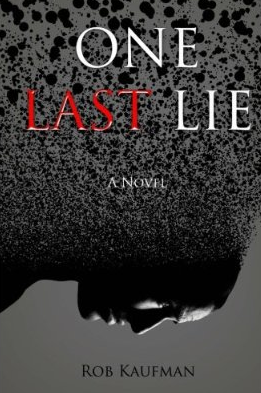
Book Review: One Last Lie, by Rob Kaufman; Tense march toward tragedy and undefeated love

Book Review by Jack A. Urquhart  ©2012

The early chapters of Rob Kaufman’s tensely wrought and engaging novel, One Last Lie, seem to herald a predictable story of ‘gayfluence’ brought low by tragedy.  Indeed, Kaufman appears to be going for that familiar paradigm by setting his novel in the wealthy enclave of Westport, Connecticut, and by employing a narrative stance that immediately establishes the fact that misfortune has already befallen his protagonists, Jonathan Beckett and Philip Stone, a successful, loving, same-sex couple who previously lived the good life in Westport’s privileged environs.

But once the novel kicks into high gear via Kaufman’s flashback storytelling, the trappings of Westport’s “A-list” gay life—designer showcase homes, couturier fashion and fragrance, celebrity restaurants (Tim Gunn couldn’t have done a better job at name dropping)—take a back seat to the novel’s unrelenting march toward a carefully plotted, suspenseful climax.

There is something simultaneously unsettling and thrilling (at least to this reader) about foreknowledge—something that keeps us turning pages in the same way that we continue perversely toward the scene of a roadside accident even when the flashing emergency lights are visible from miles away.  Those lights begin to flash in One Last Lie the moment Kaufman introduces Angela, his fascinating villainess.

Perhaps the novel’s most compelling character, Angela, a friend from Philip’s college days, charms her way around Jonathan’s neuroses-fueled mistrust (a condition described by his therapist as an “irritated state of being”) to become part of the couples’ lives.  But as with many a great villainess, Angela’s charm serves a sinister agenda—one she sets about achieving by convincing the men to have a child with her via artificial insemination.

For sheer deviousness and evil intent, Kaufman’s Angela approaches the likes of the Marquise de Merteuil in Les Liaisons Dangereuses and Lady De Winter in The Three Musketeers.  Almost as soon as the ink is dry on the co-parenting legal contract prepared by Jonathan’s and Philip’s attorney, Angela leads the increasingly anxious fathers-to-be (Jonathan is ostensibly the sperm donor) on a relentless, and at times, excruciatingly tense journey toward tragedy and the revelatory denouement foreshadowed in the novel’s title.

Speaking of denouement, it is difficult for this reader to imagine that any reader who has experienced a lasting, deeply committed loving relationship could fail to be moved by the conclusion that Kaufman offers in One Last Lie.  Tender-hearted readers should have their hankies at the ready.

The novel has a few possibly temporary flaws, some of which seem related to Amazon’s troubled HTML conversion technology for e-books.  In a few instances, the reader is jarred abruptly backward or forward in time—literally from one paragraph to the next—without benefit of a section break; however, these imperfections may also be related to Amazon’s conversion technology and its tendency to obliterate the author’s formatting choices.  Future iterations of the e-book (this reader purchased an early version) may well have eliminated these problems—snags that are hopefully altogether absent in the novel’s soft-bound version.

Ultimately a story of undefeated love couched in a tense drama of deception, betrayal, and violence, Kaufman’s novel puts the lie to the genre labels often attached to works that place gay protagonists center stage.  Indeed, One Last Lie transcends tags such as ‘gay fiction,’ ‘gay romance,’ or even ‘gay suspense/thriller’ by offering a satisfying mainstream reading experience (from the nail-biting to the hankie producing) that is suitable for a broad cross-section of discerning readers.

Jack Urquhart is the author of several works of fiction including the short story, “They say you can stop yourself breathing” and So They Say Collected Stories.  He can be followed on Twitter @jackaurquhart.

Posted in Uncategorized | Leave a comment

Dreaming My Children Safe

by Jack A. Urquhart,  ©2012 (477 words)

Lately I’ve been dreaming about my children.  I say ‘lately’ but it’s actually more of a long-standing thing, almost habitual.  Several nights a week they scamper across the landscape of my subconscious, practically careless, still small children, still obsessed with learning how to tie their shoelaces, practicing the latest breakdance moves, making igloos out of a spring snow in the back yard, squabbling over whose turn it is to feed the dog.  For those few small dreaming hours, they are no longer the grownups their years dictate.  And I can look out for them.

Then I awaken.

Then the real world closes in—that place for which I am increasingly fearful I’ve ill prepared my babes.

I encounter the evidence of this secondhand these days from the other side of the continent—a host of problems posted via e-mail, text message, Facebook, that I can’t ease away (as if I ever could).  It seems my children struggle in ways I never did, forced to make a go of it in a world governed by the things I failed to teach them—lessons that I encountered early on in the classroom, on the playground, on the job site, in Sunday school.  Want to talk about a failure of the education system?  Look no farther than the homefront!  I see the consequences of my negligence now—how my children flail in the absence of survival skills I might have drummed into their pliant, young heads.

Like the times tables of a rote intelligence; the ever useful craft of simulating respect where it isn’t deserved, or the expedience of abiding rules that ought rightly to be broken.  And, of course, the fine art of invoking God’s will toward any ends.

Silly me to have been so remiss.

Instead, my poorly educated children struggle to make ends meet by making art instead of stock portfolios, by attempting music instead of marketplace cacophony, by parsing the lingo of the street instead of spouting superstitious scripture.  Instead of brandishing parchment credentials, they parade their worldly ignorance, their emperors clothing, before the ogling eyes of the world as if were the latest fashion.  Or at least, that is how it often looks to these distanced eyes—as if I’ve sent them naked and ill-armored, no more than serfs, into a world that lords it over vulnerability, over naiveté.

Yet somehow they survive, if not exactly thrive.  Somehow they cope, even managing to display occasional acts of valor.  And how miraculous is that in today’s world?

And yet in the still of the night, I go on dreaming.  I go on dreaming my children safe.  I go on  despite awakening day after day to the same old sun-up questions.  Like:

Who would’ve guessed it could be this difficult, this excruciating, this inescapable—paying quotidian witness to the evidence of parental oversight?  Who would’ve guessed it could be this painful—watching from the sidelines as children become themselves?

Not me.

Posted in Uncategorized | 8 Comments

Book Review: Train Dreams, by Denis Johnson; A small American tragedy

Book Review by Jack A. Urquhart 

Denis Johnson’s novella, Train Dreams, is one of those elegantly understated, deceptively simple works of fiction that sneaks up on you while you thought nothing much was happening on the page. The author’s protagonist is Robert Granier, an ordinary day laborer and woodsman/quasi hermit living in the forests of the Pacific Northwest at the beginning of the 20th Century.  Shattered by the loss of his family, Granier struggles to make sense of a rapidly changing world and in the process, becomes a small American tragedy unto himself.

Johnson’s novella—it’s only a little over a 120 pages—is steeped in the mysteries and magic of nature.  For my money, the final two sentences are worth the purchase price all by themselves.

Reading Train Dreams drove home (for me) the travesty of the Pulitzer Board’s decision to forgo an award for fiction in 2012.  If Johnson’s novella–one of this year’s fiction finalists–isn’t award-worthy, then I’d like to know whose is.

A marvelous read.

Posted in Uncategorized | 2 Comments

Book Review: The Termite Queen: Volume One: The Speaking of the Dead

Sci-Fi Page Turner: Expedition into the realms of the human and the alien heart

Book Review by Jack A. Urquhart; The Termite Queen: Volume One: The Speaking of the Dead; author, Lorinda J. Taylor

Lorinda J. Taylor’s ambitious science-fiction novel The Termite Queen: Volume One: The Speaking of the Dead marks an auspicious literary debut.  A writer possessed of considerable narrative and storytelling talents, Ms. Taylor creates a 30th century adventure that, with but few interruptions, keeps the reader turning pages.

At the center of the action is Ms. Taylor’s young, ambitious, and rule-pushing protagonist, Kaitrin Oliva, an ‘Associate’ Linguistic Anthropologist (apparently there are no doctorates in the 30th century; rather, the academic hierarchy, from lowliest to most exalted, runs ‘assistant,’ ‘associate,’ ‘professor’).  Kaitrin’s expertise is brought to bear in the aftermath of a disastrous off-world expedition.  Her task: decode the bioelectric communication patterns of an alien specimen—a giant termite—collected during the unhappy mission.  Kaitrin’s linguistic and intuitive gifts soon yield a surprising conclusion: the termite, who suffers an untimely and poignantly rendered demise once removed to earth, is an intelligent life form.

Soon preparations are afoot for a second expedition to the termite planet and Kaitrin joins the team headed by the enigmatic (and sometimes downright oblique!) Griffen Gwidian, Professor of entomology.  The two get off to a rocky start, but gradually their relationship morphs into the novel’s central love story.

Interspersed with Kaitrin’s and Griffen’s story is an equally tempestuous second storyline unfolding amongst the inhabitants of the termite planet.  This reader confesses to savoring the termite chapters—written in the manner of a play—for the communal culture mindset Ms. Taylor skillfully creates.  Her termite aliens—despite genetically embedded caste and belief systems (the latter understandably rooted in a ‘Great Goddess’ concept)—mirror mankind’s record for machinations of the type that flare when competing egos collide.

It should be noted that Ms. Taylor, an active member of the ‘conlang’ community (constructed or planned languages) has devoted extraordinary attention to developing, explicating, and rendering in text, the varied languages of her cast of dozens.

Given the author’s interest in linguistics, it is not surprising that The Termite Queen is propelled by dialogue—a writerly skill at which Taylor excels.  Volume One features pages and pages of dialogue rendered in character-specific voices.  With few exceptions, these conversations, and a minimally intrusive narrative voice, drive the story, building tension and momentum while revealing and/or suggesting the mysteries and foibles of the human and the alien heart.

A word about those rare exceptions.  Some readers may stumble over the portions of the novel that seem inserted to provide context and historical background (this reader had occasionally to resist the urge to skim).  For example, chapter 14, part one, pauses to summarize 900+ years of earth history prior to the 30th century; chapter 9, part two, presents a discussion (between characters) of interplanetary religious customs and practices, while chapter 10, part two, introduces an overview of interplanetary marriage customs and practices.  These interludes are not without interest, but they do suspend—however briefly—the story’s forward momentum.  Yet, given Ms. Taylor’s remarkable attention to detail, this reader is willing to trust that nothing has been included that will not eventually—with the release of volume two (?)—serve to facilitate a richer, fuller understanding of the novel.

Finally, a word about Ms. Taylor’s interplanetary cast of characters and their otherworldly, tongue-twisting, eye-ball-popping appellations.  The Termite Queen Volume One is filled with names to which the reader may occasionally have trouble attaching a personality.  Some examples: Mo’gri’ta’tu, Kwi’ga’ga’tei, Ki’shto’ba Huge-Head, Hi’ta’fu, A’a’ma, to ‘name’ a few.  The phonetically challenged reader may find it useful, as I did, to develop a sight vocabulary—a 21st century strategy for navigating a vividly rendered, rewarding, and compelling 30th century universe.

Avid readers of science fiction may also find it useful to visit Ms. Taylor’s blog site http://termitewriter.blogspot.com/ for additional information and explication of her 30th century world and its human and alien inhabitants.

Conclusion: Highly recommended.

Posted in Uncategorized | 1 Comment

Fault Zone

A Short Story (approximately 1780 words)
by Jack A. Urquhart © 2012

Earthquake Richter Scale

Anyone with eyes could’ve seen them—the pedestrians approaching behind the car.  It wasn’t his fault Declan hadn’t.  True, he could have spoken up.  But it had all been so obvious.

It’s not my responsibility to play lookout for a grown man, Luke told himself.

Declan apparently thought otherwise.

“Another second, and I might’ve hit them,” he barked, his face collapsing into a bull-doggish grimace.  “How come you didn’t say something?”

Luke turned to look out the window.  Leave it to his partner to pass the buck—and to disallow room for response.

“I don’t know why people can’t wait five seconds when they see a vehicle backing up!”

Luke opened his mouth and then thought better of it.  No telling what might pop out; probably something leading to more bickering and they’d already squandered enough time on that for one day.

Like the squabble that had erupted an hour earlier.

“Sorry.  Closing went long.  Par for the course in Real Estate,” Declan had offered peremptorily, like it was no big deal being late three times in as many days.  “Difficult to phone home when there’s a twenty-thousand dollar commission in the balance.”

Luke had been unable to resist biting back.  “Right, Dec.  I can see how a phone call would be too much for your secretaries.  Either one of them,” his riposte.

The end result—would he never learn?—had been a clash that accomplished nothing save to further delay their departure for a rare evening out.  As usual, Declan managed the last word.

“I don’t know why you need to go for the jugular when I mess up.  I said I was sorry.  Why pour sarcasm on the small things?”

Small, indeed!

And now on top of everything, this incident in the parking garage.  The whole thing avoidable.

Who in their right mind pulled into a one-way entrance, and then backed right back out again—across a crowded sidewalk!  All for a savings of two dollars!

“Why pay ten bucks when we can park for eight down the street,” Declan said testily when Luke had asked what he was doing.  “You’re so ready to throw money away?”

Before Luke could reply, they were in reverse, Declan looking over his shoulder directly at—or so it seemed—the pedestrians heading their way.  A miracle they hadn’t hit the leader of the pack.

An even greater miracle a worse scene hadn’t ensued.

“Stupid Fuck!” the thuggish young man—sporting more piercings than a pincushion—snarled, thrusting his face up against Luke’s window.  “Buncha fags!  Get a fuckin’ horse!” he’d screamed, smashing his fist down on the car roof.

Luke had known immediately the blow would leave a dent.

Twenty minutes later, after they’d found parking in another garage, he examined the damage.

“Looks like we’ve got a war-wound,” he said, forcing a calm he didn’t feel.

Standing next to him, Declan examined the dimpled roof, lips curled into a smirk.

“Jerk was a homophobe!” he snarled.  “Bunch’a hoodlums and hustlers.”  And then, perversely, “I don’t see a dent.”

Luke clenched his jaw.  A crater the size of a hubcap and the man’s response would’ve been the same, he felt certain.

“Let’s eat,” Declan said turning on his heel to head for the exit stairs.  “Only an hour till the movie.”

Right.  The movie.  The one they’d never make.

Five flights later, engulfed in the crowds along Polk Street, Luke paused to zip his jacket against the brisk San Francisco evening.  When he looked up, Declan was already well ahead, same as ever.  No matter that Luke had longer legs; Declan consistently outpaced him.

“How about calzone?  Sound good?” Declan, holding up, called back to him.

Luke pondered the question.  A hundred restaurants to choose from, and none appealing.  Why wasn’t there a place, a decent place that served ordinary food?  “Sure, Calzone’s fine, if you like,” he replied.  And then, “what else is there in this neighborhood?”

Declan thrust his hands into his pockets and turned away.

“There he goes,” Luke mumbled, irritated.  These days cross-eyes was enough to snap Declan into a sulk.

“There must be a dozen places on the next few blocks,” Declan bawled back at him.  “If not calzone, then what?  It would help to know what you want,” he grumped.

“Calzone’s okay,” Luke sighed.  “No time to look anyway.”

“Fine!” Declan snapped, quick-stepping ahead.

At the end of the block, waiting for the traffic signal, Luke approached the window display at the corner liquor store.  An unfamiliar brand of vodka was oddly displayed as on a lady’s fancy vanity table, mirrors and costume jewelry coupled with the opalescent-colored bottles, everything draped in strands of fake pearls.

He was studying the arrangement, trying to fathom the window-dresser’s marketing strategy, when it began—a collective shuddering, like all creation attempting to shake a chill in a simultaneous shiver.

It was the vibrating plate glass, the bottles chattering in the window—the way some of the pearl strands slipped off—that made him realize the motion wasn’t from passing traffic.  And then the strange sensation of lateral movement, and the noise—like a locomotive moving underground.

Before Declan shouted, Luke knew it was a quake.  Two seconds more and somehow Declan was behind him, yelling, pushing him away from the storefront.

“Stay away from the window!  It could shatter!”

And just like that, it did.

Luke heard the crackling sound behind them, like breakfast cereal on steroids, followed by the crescendo of shattering glass.  Ten seconds more and it was over.  The tremor rolling away, a wave headed for a distant shore.

In its wake, several car alarms were left crying wolf—the racket wah-wahing up and down the length of Polk Street.

A group of teenagers yelped from the opposite corner.  “Shit!  That was fun!” one of them cried.  Next to the liquor store, a less ebullient group of tourist types spilled from a Thai restaurant.

“Good gracious!” one of them, matronly in her pastel pantsuit, whooped, eyeing the shattered glass.  “Thank the Lord we don’t have nothing like that back in Arkansas!”

“Only an occasional twister,” Declan deadpanned sotto voce.  And then, “Prob’ly just a 4-pointer.  Happens everyday somewhere.”

Shaken, Luke tried to remember the last quake—difficult since he often thought he could feel the earth moving.

Sometimes deep in the night, with Declan asleep beside him, the house seemed to quiver, as if something at the earth’s core had stirred in its dark slumbering place.

“Looks like the touristas had a scare,” Declan said, ready to move on.  “You all right?”

Luke half laughed.  “Just a bit, a bit—rattled.  I guess you never get used to these.”

Quakes were like seismic temper tantrums, it came to him—snatching at the earth beneath your feet, roiling away in seconds, leaving you stunned and embarrassed, newly acquainted with what it meant to be…breakable.

Declan shrugged.  “Goes with the territory,” he said.  “Better hurry.”

It was when Declan turned that Luke noticed the glass shards, like trapezoidal raindrops, clinging to Declan’s shoulders, to the back of his good wool jacket.  And something else—a tiny drop at the nape of Declan’s neck the size and color of a holly berry.

Instinctively, he reached for Declan’s arm.

“Wait.  There’s glass all over you.  And you’re—I think you’re bleeding,” he gulped, searching for his handkerchief, wondering why it was that the sight of blood brought flutters.

Not Declan.  Already he was craning his neck, positioning himself in front of a window searching his reflection.  Luke had to restrain him from brushing barehanded at his shoulders.

“No!  You’ll cut yourself!  Let me do it,” he said, grasping Declan’s shoulders, pivoting him toward the street light as he swept away the shards with his handkerchief.  “Give me yours,” he added, all business, reaching for the monogrammed linen square in Declan’s hand.  “Is it clean?”

Still twisting his head to see, Declan pulled a face.  “Com’on, it’s just a nick.”

Luke wasn’t convinced.  “Be still.  Turn around,” he barked, eyes riveted to the scarlet spot soaking through white linen.  Proof of life.  Proof of something.  But what?  “Maybe you’ll need a stitch,” he said, lifting the handkerchief before blotting again.

Declan sighed.  “Maybe I won’t.  Maybe it’s just a scratch.”

“What if it had been a bigger piece?  You could’ve been killed!” Luke croaked, swallowing hard.  “A cut like that—next to your jugular!”

Declan eyed him askance and allowed a small laugh.  “My jugular’s over here,” he said, placing his finger on the spot.  “And it wasn’t a big shard.  It was a splinter.  See?  The bleeding’s stopped.”

But Luke wasn’t listening.  “I couldn’t have stood it.  I’d die,” he said, his mind galloping into an imagined future that seemed all too plausible.

This time, Declan’s laughter echoed up the street.  “No, I’d have died,” he said.  “Remember?  It’s me there, decapitated, in your little imagined soap opera.”

Shocked back into his skin, embarrassed to be caught singing ‘solo’, Luke laughed self-consciously.  But there was no hiding from it—nothing to do save acknowledge the ridiculous, the ludicrous moment of smallness and egotism and naked regret.  “Well then…we’d both have died,” he parried, teetering on the verge of laughter, or was it—Oh God, he hoped not!—something else.  And then, letting go: “I’m so sorry!  It was my fault back there,” he gasped.  “I was stubborn, self-centered.  I should’ve spoken up in the…”

“You should’ve thought twice about moving into quake country, you mean,” Declan interrupted, shoving his arm through the bend in Luke’s elbow to lead him across the street.  “But then, you’d never have finagled a prize like me, would you?”

No.  No, I wouldn’t have, Luke thought.  Not in a thousand years.

“Like I said, comes with the territory,” Declan said, maneuvering them through the bustle of imperfect humanity.  “Some days are shakier than others.  Nothing like living in a fault zone.  Now about that calzone…”

Luke blew his nose into the handkerchief balled in his hand, noticing too late the single scarlet spot on white linen.  He laughed in spite of himself.  “I’d rather have Chinese,” he said.  “Screw the movie.”

Declan, laughing out loud, squeezed his arm.  “Just waiting for you to say, Babe.  Can’t blame me for that.”

Luke shook his head and swayed closer to his lover—until they were shoulder-to-shoulder.  Until there it was—rhythm, the two of them moving apace.  Step for step—at least for the time being.

Sure I could blame you, Luke thought, considering how easy, in fact, that would be.  Sure I could, he admitted, smiling to himself.

Comes with the territory, he allowed.

END

Posted in Uncategorized | 4 Comments

Indie Book Reviews: Objective Notice or Subjective Fanfare?

By Jack A. Urquhart, ©2012

The Critics' Circle logo

It is with trepidation that I undertake this long-winded piece, the topic of which is indie book reviews and my questions and misgivings about same.

I say trepidation because it could be that I’m missing something; it could be that with regard to reviews and their creators, I’m not savvy enough ‘to get’ how things work in the Indieverse.  It could also be that by publishing my questions and concerns here, I guarantee for my current and future work a permanent place in indie exile, a place where my stories will never again be granted a single sentence of critical notice.  I hope that isn’t what happens, for I pursue this post with no malicious intent.

But to get on with the pursuit…

In the interest of full disclosure, I’ll begin by recounting that I recently paid for an expedited Kirkus’ review of my short story collection.  I decided on the Kirkus’ investment because of my concerns about the objectivity of some of the indie reviews I’d read online and because of the difficulties I’d experienced in obtaining notice via several of the well-known Internet review organizations.

In fairness, I’d expected that the length of my tome—some 670 odd pages in paperback form—would be an obstacle in securing a review from these organizations whose team members, for the most part, receive no compensation (other than an endless supply of free reading material) for their considerable efforts.  For that reason, I released several of the individual stories from my collection as stand-alone e-books and focused my efforts on obtaining reviews for those few pieces.  With that goal in mind, I visited multiple review team web sites, read the reviewer profiles, studied the organization’s requirements, and then carefully composed and duly sent off six e-mail requests for a review—each request for a separate story or small group of stories.

That was nearly four months ago.

To date I’ve received one review from an online review team member, as well as three individual reader reviews—responses for which I am grateful in the extreme.  Indeed, my gratitude cannot be over-emphasized; that is because, having written seven reviews myself during this same period (five of them for independently published authors), I know well how formidable is the investment in producing a credible, hopefully objective review of another author’s work.

As for the remaining five review queries forwarded all those months ago, three cursory e-mail ‘acknowledgements of receipt’ have found their way into my inbox—none of which has, as yet, resulted in a published review.

I can report that a few weeks ago one review team member did stir up a brief flutter in the Twitter feed by announcing that they had undertaken to read one of my stories; but then, complete silence.  Seems my story had failed to impress.  That happens.  Tastes vary.  Nothing untoward in that.  I was disappointed but not offended.  Best to keep writing, I decided; best to hope for better luck with another reviewer.

But then, a conundrum: what, I began to wonder, was to be made of the promotional posts I’d begun noticing in the Twitter feed—tweets by review team members that seemed to indicate a relationship between themselves and numerous frequently reviewed authors?  Those tweets seemed to suggest a kind of fraternization that didn’t jibe with my traditional notions of objectivity.

Then I considered—perhaps things had changed so drastically in the industry that old-fashioned concepts of objectivity didn’t apply.  Perhaps in the Indieverse, those concepts had become nothing more than parochial artifacts, quaint notions that were irrelevant in the social media marketplace that authors and their reviewers currently share?

Maybe the primary responsibilities of the author/content creator and the reviewer/evaluator of said content no longer required any degrees of separation?  Maybe my notion of those responsibilities was completely outdated?  Notions that held that while the author shouldered the burden of producing content of the highest quality his or her individual talents could muster, the reviewer was charged with reading and then rendering for the prospective customer a cogent evaluation of that content with as much objectivity as his or her gifts of perception, analysis, and rhetoric could permit.

But wait!  It seemed to me that those very responsibilities, at least those associated with the reviewer/critic, closely mirrored the mission statement featured on some of the best known indie review team web sites—i.e., to provide an objective ‘filter’ (presumably against literary imperfections) that would be useful to readers in choosing their library.  That was, it seemed to me, a worthy mission; but wouldn’t it be compromised if anything other than the reviewer’s objective reaction to the writer’s material passed through the filter—impurities such as, for example, anything carrying a tinge of promotion or favoritism?  Wouldn’t any such rift in the filter muddy the waters between objective evaluation and something more akin to fandom or even those duties more closely associated with a publicist?

Note that I am referring here not to individual readers whose published response to a book might understandably be influenced by their preference for a particular genre, or even shaped by their familial relationship (spouse, brother, sister, friend) to a given author.  Rather, I refer to those individuals who are affiliated with the previously referenced review teams—organizations (however loosely held) whose mission statement would appear to carry the burden of objectivity, or some modicum thereof.  Is it possible for those individuals to discharge that mission while maintaining a relationship—even a cyber relationship—with an author whose work they have been called upon, or might be called upon, to judge?

Consider the following hypothetical tweets, which are typical, I think, of what one encounters in the Twitter feed.  Does the difference between:

Anne Arbiter @annearbiter
My 5* review of H. Diddle’s scintillating page-turner #CowsOverTheMoon at bitly.me/abc member LottaRevws.com

and this,

Anne Arbiter @annearbiter
Rave reviews continue 4 H. Diddle’s #CowsOverTheMoon Congrats 2 Diddle. I’m a huge fan. My 5* at bitly.me/abc member LottaRevws.com

matter at all?

And what about a tweet such as:

Anne Arbiter @annearbiter
H.Diddle just told me about her new novel #CowsOverTheMoon. Going 2 be terrific. Can’t wait to read it.

Does that kind of tweet, posted by a well-known reviewer, suggest favoritism and compromise any semblance of objectivity?  Or does that no longer matter in the Indieverse?

And finally, what if a known review team member allows himself to be interviewed on an indie author’s web site?  What if, during the course of the interview, they offer a promo for their favorite book by said author—an author whose work they have previously reviewed?  Would that matter?

I’m asking.

Perhaps you will think I am too hard on review teams in posing these questions.  You might even exclaim, “But they aren’t professionals!”

As previously mentioned in this piece, and as most indie book review organizations disclose on their web sites, most review team members receive no compensation for their work [1].  Why then make a stink over any non-compliance with fussy standards of objectivity?

Only consider the following questions in formulating your answer: Would an indie author in his/her right mind discount the importance of obtaining multiple and impartial reviews when it comes to building market credibility and sales figures, especially when most indie authors cannot expect their work to be taken seriously in the absence of twenty or more reviews?  And who provides a goodly portion of those reviews?  Indie Review organizations and their team members?

And let’s return for a moment to the notion of professional status in the traditional sense of the term:  Is that even relevant in the Indieverse?

After all, very few of us operating as Independents—writers, publishers, bloggers, reviewers—are remunerated, much less adequately, for our efforts.  Couldn’t one argue that for the most part, we are all then, by the de facto standards of market dominance, under-compensated professionals, or at the very least, semi-professionals—Indie team reviewers included?  Doesn’t the role indie-team reviewers play—i.e., providing primary source opinion pieces and/or summary reviews of an author’s work—underscore that premise?

Aren’t indie review teams providing services crucial to the success of the indie author? And if that is so, shouldn’t they endeavor to maintain some semblance of objectivity in the authors they choose to notice, in the reviews they produce, and even in their tweets?

As I mentioned in the first sentence of this post—these are questions that worry me, issues on which (it must be patently obvious) I have definite opinions but can claim no special expertise.  Indeed, I bring up all the forgoing fully aware that there are factors I’ve overlooked, that I’ve not thought of—factors that may account for what I’ve experienced, what I’ve observed.  If I’ve missed something, erred in my observations, based my opinions on mistaken assumptions, then I am eager to be disabused.  But I am even more eager to learn how an independently published author like myself might more effectively navigate the route to critical notice.

Your comments, opinions, advice is more than welcome here.

[1] It is worth noting that many review team web sites accept paid advertising—revenue that while not shared with the individual team members, covers web site expenses and, in some cases, presumably provides some compensation to the web host, who may or may not be a review team member.

Posted in Uncategorized | Tagged | 18 Comments

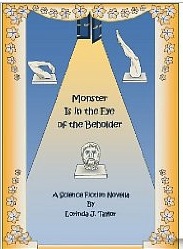
Monster Is in the Eye of the Beholder, by Lorinda J. Taylor

Well-Intentioned Scientists Running Amok

Book Review by Jack A. Urquhart ©2012

Lorinda J. Taylor’s imaginative and entertaining science-fiction novella, Monster Is in the Eye of the Beholder, reminded this reader of Mary Doria Russell’s The Sparrow (1996).  Both works are first-contact stories that turn on what happens when human beings, acting with best intentions, behave in ways that cause catastrophic damage.  Doria Russell and Taylor both explore the nature of good and evil, cultural difference, and prejudice, and both choose to tell their stories, for the most part, in framed flashbacks.

Taylor’s epistolary Monster…, set in the year 3001, relies on official reports and journals/recordings kept by the major characters to tell the story of a first scientific expedition to the Planet Kal-fa.  The story gets off to a quick start when a group of human xenoanthropologists encounters the Kal, a peaceful, telepathic, and spiritually evolved civilization of ‘teratoids’.

The expedition leader is Professor Kaitrin Oliva, a scientist so enamored of life’s infinite variety that she fails to heed early signs that her expedition is heading toward disaster.  The mission seems to be proceeding splendidly; however, two of the human scientists are gradually running amok, one of them via an egregious ethical lapse that, in turn, triggers long-repressed psychological and moral defects in the other—defects exacerbated by exposure to the teratoidal Kal.  Speaking of the Kal, to reveal more here of their physical appearance and characteristics would be to ruin the credulity-straining surprise of why Taylor has used the term ‘teratoid’—i.e., monster-like—to describe them; suffice to say, no scientific expedition is likely to encounter a more ‘detached’ group of beings.

Taylor does a fine job building to the violence that ends the expedition.  Likewise, she deftly handles the official ‘inquisition’ in the wake of the mission’s failure, as well as the novella’s surprising, if somewhat unsettling parting shot (apparently humans aren’t the only species to suffer from cultural myopia).  It is also commendable that, like Doria Russell, Taylor pays attention to anthropology, sociology, linguistics, and religion in her novella—a welcome change from the traditional hard-science emphasis that pervades so much science fiction.

It seems appropriate to offer a few words about Taylor’s narrative stance.  The epistolary form has its pros and cons.  It can be employed to reveal a character’s most private, intimate thoughts, and is especially powerful when used to reveal the innermost longings and conflicts of characters operating in actual and/or emotional isolation (think Mary Shelley’s Frankenstein).  Conversely, the epistolary stance can distance the reader—and not always in good ways—from the action of the story.  That is to say, if the reader is too often reminded that what she is reading has already happened, then any more visceral, immediate connection to the characters and their various dilemmas is likely to be reduced.  In such cases, it is almost as if the epistolary character/narrator is telegraphing the reader: “Don’t worry!  Obviously, I’ve survived this episode–otherwise, how could I be recounting it?”  Perhaps that is why this reader found the longest journal and report entries in Taylor’s Monster to be the most engaging; when the story was allowed to run on to six or eight pages, it was easier to forget that the action wasn’t taking place now (suspension of disbelief).  On the other hand, the shorter journal/report entries featured in Taylor’s work tended to interrupt and flatten the story.  But that is perhaps a purely subjective reaction, and, in any case, a minor flaw in an often engaging and thought-provoking story.

Posted in Uncategorized | 3 Comments